This document, titled “The Red Pill Moment – How Leaders Win: Changing Perception in the Age of AI” by Adam B. Bloom, provides a comprehensive guide for CEOs, operators, and business leaders to navigate the transformative impact of generative AI on organizations. Below are the key points:
Core Premise
- Generative AI as a Structural Shift: AI is not a tool to adopt but a permanent operating condition that rewrites the rules of knowledge work, decision-making, and organizational structure.
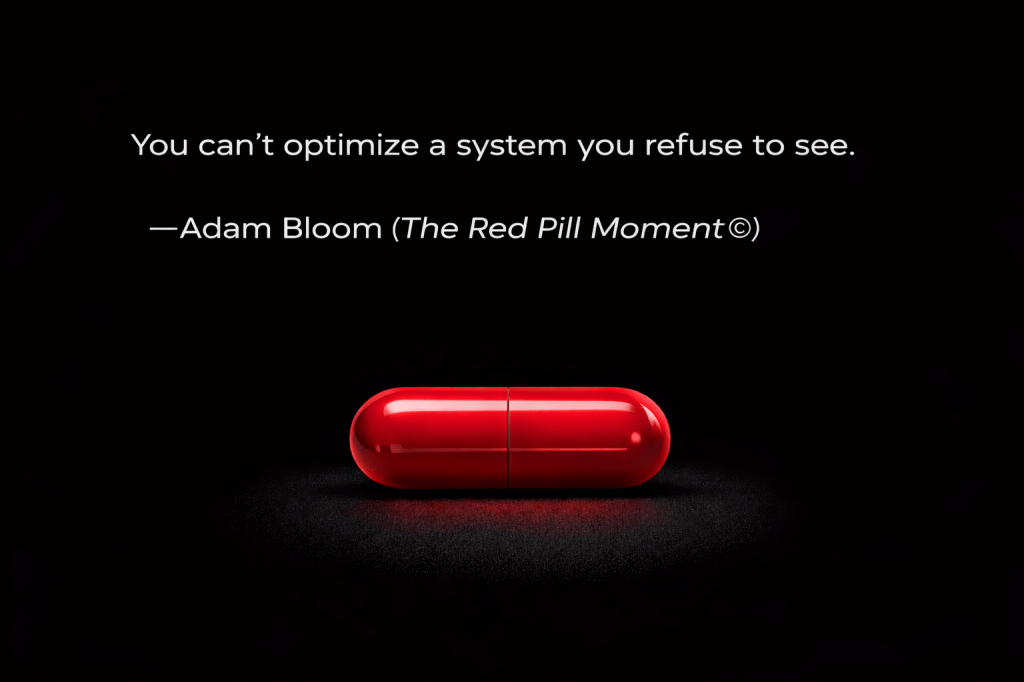
- The Red Pill Moment: Leaders must recognize that AI has already changed the way organizations operate. The choice is whether to adapt deliberately or let the organization decay by default.
Key Themes
- Past Playbooks Fail: Traditional governance and transformation models built for intelligence scarcity are obsolete in the age of AI abundance. Incrementalism leads to exposure, not caution.
- The Illusion of Control: Governance through policy overlays is insufficient. Real control comes from coherent system design, auditability, and embedded intelligence.
- Collapse of Knowledge Work: Generative AI compresses cognitive labor, decoupling effort from value. Organizations must shift from activity-based metrics to outcome-based accountability.
- End of Functional Organizations: Functional silos optimize activity but fail to deliver integrated outcomes. AI-native organizations must adopt outcome-centric teams with embedded intelligence.
- CRM as a System of Intelligence: CRM must evolve from record-keeping to answer generation and decision support, with seeded knowledge, constraints, and audit trails.
Rebuilding Organizations
- Intelligence as Infrastructure: AI must be treated as a foundational layer, with language as the control plane for configuring workflows and decisions.
- Programming in English: Leaders must learn to write operationally, as language becomes executable and defines system behavior.
- Trust Over Control: Governance shifts from supervision to auditability, ensuring traceable and reliable outputs.
- Outcome Ownership: Organizations must move from functional optimization to outcome-centric teams that integrate intelligence directly into delivery.
Leadership in the AI Era
- New Executive Roles: Executive responsibilities shift to stewarding system properties like coherence, reliability, signal integrity, and meaning.
- Human Obligation: Leaders must preserve dignity, agency, and preparedness for employees in a world where cognition is abundant and execution is fast.
- Clarity Over Comfort: Leaders must accept the reality of AI as a permanent operating condition and redesign their organizations accordingly.
Sales & Marketing Transformation
- Generative AI in Sales & Marketing: AI can drastically improve productivity (up to 100x) in content creation, customer inquiry handling, and strategic messaging.
- Product-Led Growth (PLG) + Gen AI: Generative AI will further disrupt the PLG model, automating human interactions with products and media.
- Customer Experience (CX): Generative AI can enhance CX by automating content generation and customer inquiries, reducing costs and improving efficiency.
Technical and Operational Insights
- Prompt Engineering: Designing effective inputs and outputs for AI systems is critical and requires iteration and testing.
- Development Processes: Agile, rapid iterations are essential for Gen AI implementation, as traditional waterfall methods are too slow.
- App Selection: Choosing the right Gen AI tools is high-risk due to the nascent market. Prioritize business value and integration.
- Roadmap for CRM + Gen AI: Start with pilots to learn and iterate, then scale to department and cross-department levels for integrated solutions.
Conclusion
- The Red Pill Choice: Leaders must embrace the reality of AI and redesign their organizations to thrive in the AI-native era.
- Leadership Responsibility: Leaders must ensure clarity, accountability, and trust while preserving human dignity and agency.
- Call to Action: Start pilots immediately, focus on content/media generation, and prepare for the structural and human transitions ahead.
Final Thoughts
The document emphasizes the urgency for leaders to act decisively, redesign their organizations, and embrace generative AI as a transformative force. It provides practical frameworks, insights, and examples to guide leaders through this journey while maintaining ethical and human-centered principles.
 A.Bloom & Co. | © 2026
Leave a comment