
Date: March 8, 2026 (Test A)
Author: Adam Bloom
Company: Block, Inc. (NYSE: XYZ)
Industry: Fintech / Financial Services
Initiative: Goose AI Agent Deployment → Structural Workforce Reduction
Executive Summary
On February 26, 2026, Block CEO Jack Dorsey announced the elimination of more than 4,000 jobs — nearly 40% of the company’s workforce — directly attributing the decision to the capabilities of an internal AI agent called Goose. The company shrank from over 10,000 employees to just under 6,000, not during financial distress but at the close of one of its strongest-ever years (2025 full-year gross profit: $10.36 billion, up 17% YoY). Dorsey’s shareholder letter was unusually candid: “Intelligence tools have changed what it means to build and run a company. I don’t think we’re early to this realization. I think most companies are late.”
This case study documents how Block’s Goose deployment demonstrates five confirmed Red Pill Moment patterns — AI agent deployment, pilot-to-platform transition, knowledge work role compression, intelligence infrastructure build-out, and copilot-to-redesign escalation — mapping to five core RPM principles. The Goose story is also notable for what it reveals about the humanitarian question: Block’s severance package was financially generous, but the company offered no publicly disclosed reskilling or redeployment program. The cut was clean, quick, and unapologetic. Whether that represents honesty or abdication depends on how you frame leadership’s moral obligation in the AI era.
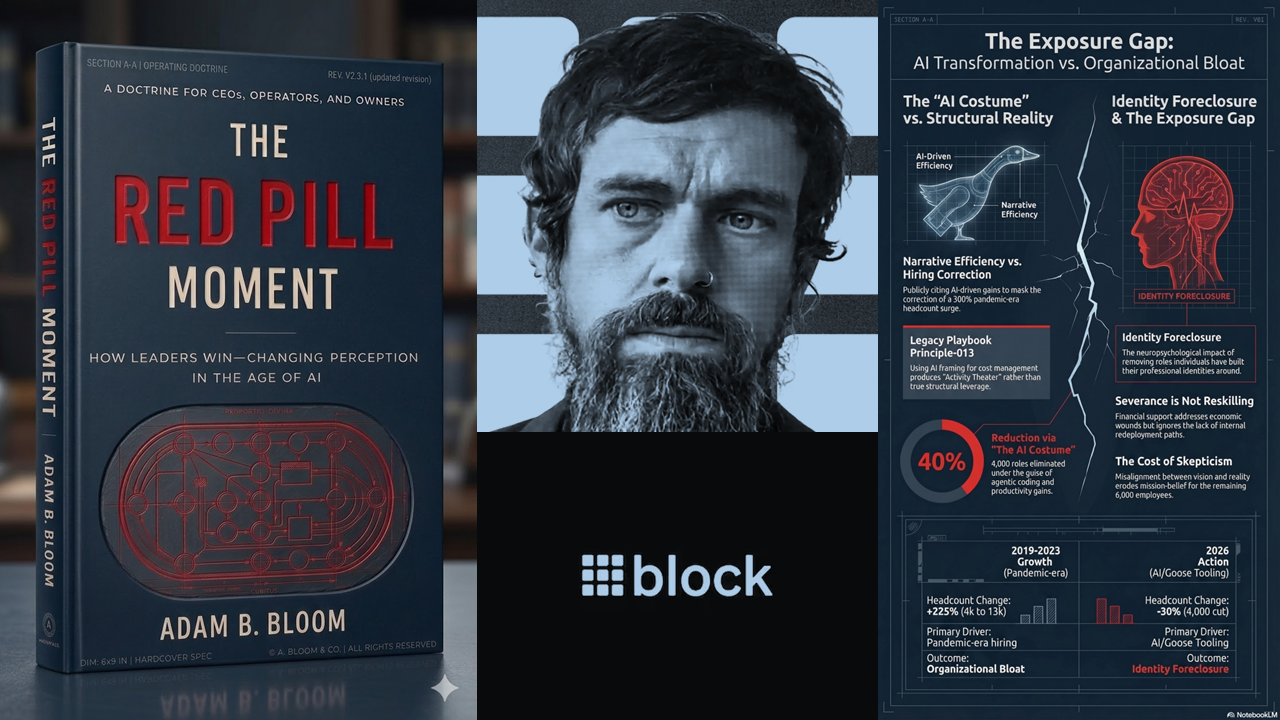
Company Background
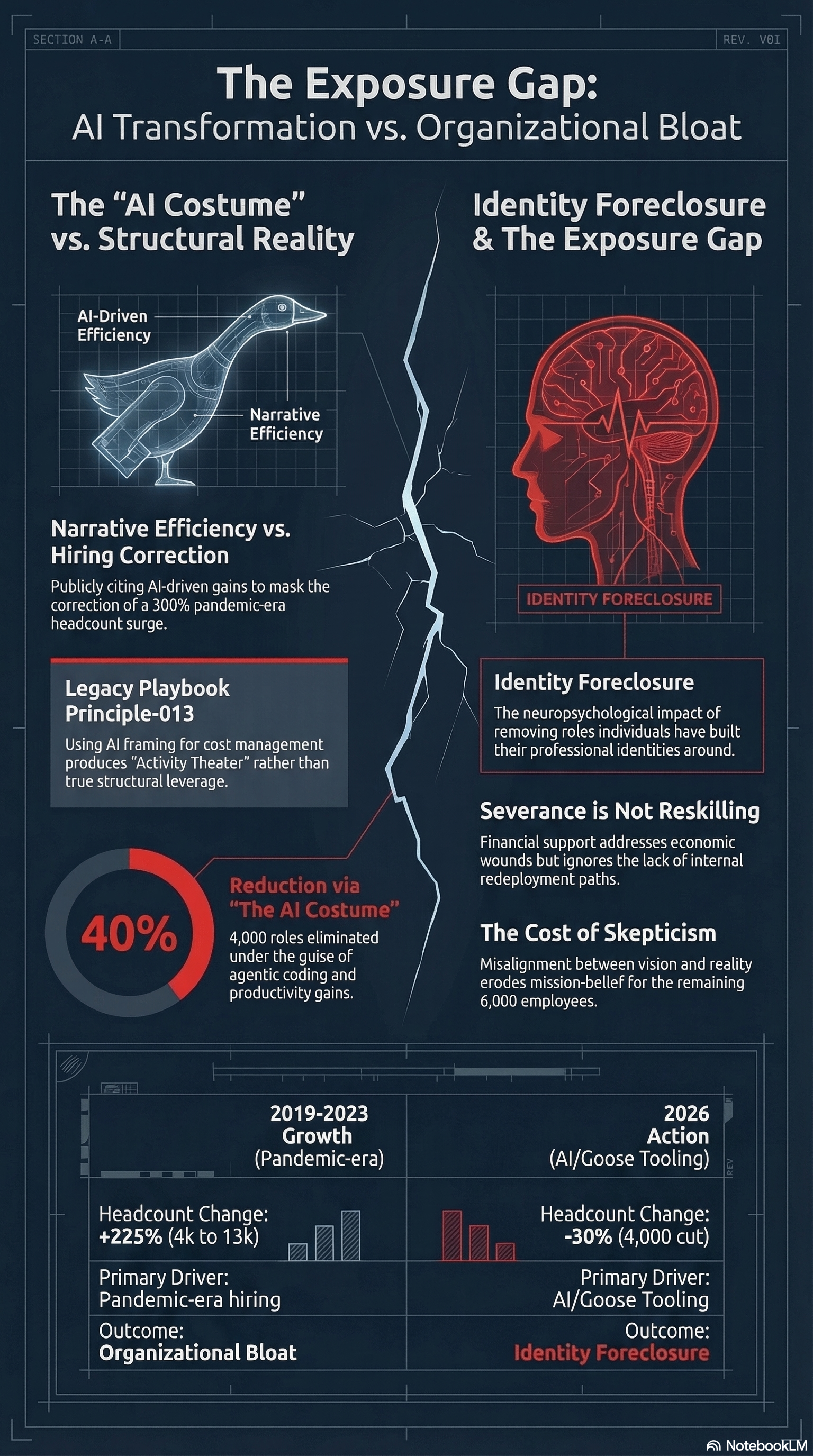
Block, Inc. (formerly Square) is a fintech company founded by Jack Dorsey and Jim McKelvey in 2009. By 2025, it operated four principal businesses: Square (point-of-sale and financial services for sellers), Cash App (consumer payments and banking), Afterpay (buy now, pay later), and several Bitcoin-focused ventures (Bitkey, Proto). The company grew aggressively during the pandemic era, expanding from approximately 3,835 employees at end-2019 to over 10,000 by end-2025.
Block is relevant to RPM analysis for two reasons. First, it is one of the few companies to have built a named, enterprise-deployed AI agent internally — Goose — before deploying it at scale and reducing headcount explicitly because of it. Second, Dorsey’s public framing was unusually direct: he did not use “efficiency” language or “streamlining.” He said intelligence tools had changed what it means to run a company, predicted other companies would reach the same conclusion within a year, and then signed a letter to shareholders while the stock rose 24% in after-hours trading. This is the Red Pill Moment as public announcement — rare, documented, and analyzable.
What They Did: Timeline of Events
Early 2024 (estimated): Block begins internal development of Goose, an AI agent framework for software engineering tasks, built by a small team of approximately 12 specialists in collaboration with Anthropic. The project starts as an internal engineering experiment.
Late 2024: Goose is deployed internally to approximately 1,000 engineers (roughly 20% of Block’s engineering workforce). Early productivity metrics report 20% time savings; in one demonstration, Goose rewrites 70% of a platform’s code in a different programming language in 30 minutes — a task that would take a principal engineer hours or more.
January 28, 2025: Block’s Open Source Program Office publicly launches “codename goose” — an interoperable AI agent framework built on the Model Context Protocol (MCP). CTO Dhanji Prasanna states that Block engineers are already using Goose “to free up time for more impactful work.” The open-source launch under Apache 2.0 signals Block’s intention to treat Goose as platform infrastructure, not proprietary competitive advantage.
March 2025: Block conducts a round of layoffs affecting approximately 1,000 workers, demotes around 200 managers, and closes approximately 800 open roles. This is framed as performance-driven restructuring, not explicitly AI-related.
September 2025 onwards: Engineering productivity gains from Goose accelerate. By this date, production code shipped per engineer has increased over 40% compared to six months earlier, according to Block’s Q4 2025 earnings disclosures. Goose expands beyond engineering into sales, operations, and non-technical functions. Dorsey mandates that all employees use AI tools daily; AI fluency is embedded into performance evaluations.
September 30, 2025: CTO Prasanna appears on Sequoia Capital’s “Training Data” podcast, revealing Block has reorganized from business unit silos to centralized functional teams specifically to enable AI adoption. He describes Goose as on track to save 25% of manual hours across the company, with engineers saving 8–10 hours per week.
October–November 2025: Block conducts a further round of layoffs affecting approximately 1,100 employees. Combined with the March round, total headcount reductions in 2025 exceed 2,000 before the February 2026 announcement.
December 2025: Dorsey cites a specific inflection point: a step-change improvement in underlying model capabilities. On the Q4 earnings call, he states: “Something happened in December just last year, where the models just got an order of magnitude more capable and more intelligent, and it’s really shown a path forward in terms of us being able to apply it to nearly every single thing that we do.”
December 9, 2025: Block contributes Goose to the Linux Foundation’s newly formed Agentic AI Foundation (AAIF), alongside Anthropic’s Model Context Protocol and OpenAI’s AGENTS.md. This signals Goose’s status as foundational infrastructure for the agentic AI ecosystem — not just an internal tool.
February 26, 2026: Block announces Q4 2025 earnings simultaneously with a workforce reduction of more than 4,000 employees (40% of headcount), bringing total staff to just under 6,000. The move is announced in conjunction with raised 2026 guidance: adjusted EPS of $3.66 (54% growth), crushing analyst estimates of $3.22. Affected employees receive 20 weeks of salary plus one week per year of tenure, equity vested through end of May, six months of healthcare, corporate devices, and an additional $5,000. Block’s stock rises 24–27% in after-hours trading.
Evidence Analysis
Primary Evidence
Official Announcements:
- Block’s January 28, 2025 press release announcing codename goose open-source launch, citing Block engineers already using it to free up time for “more impactful work” (block.xyz)
- Dorsey’s February 26, 2026 shareholder letter: “The core thesis is simple, intelligence tools have changed what it means to build and run a company… A significantly smaller team, using the tools we’re building, can do more and do it better.”
- Dorsey’s X post on severance package details, February 26, 2026
- Block’s December 2025 contribution of Goose to the Linux Foundation Agentic AI Foundation (linuxfoundation.org)
Earnings Calls / Investor Materials:
- Q4 2025 earnings call (February 26, 2026): Dorsey explicitly names Goose as the enabling factor, cites the December 2025 model capability inflection point, and notes Block was “the first agentic harness out in the market”
- Q4 2025 earnings summary: Production code shipped per engineer increased over 40% since September 2025 due to AI tool adoption (multiple transcript sources)
- CFO Amrita Ahuja: “We see an opportunity to move faster with smaller, highly talented teams using AI to automate more work.”
- 2026 guidance: adjusted operating income raised to $3.2 billion (54% growth), anticipating six points of margin expansion
Organizational Changes:
- CTO Prasanna told Sequoia’s “Training Data” podcast (September 30, 2025) that Block “unwound” its GM/business-unit structure in favor of centralized functional teams to enable AI adoption — a structural reorganization preceding the workforce reduction
- Block mandated daily AI tool use for all employees, with AI fluency integrated into performance reviews
- Dorsey implemented a weekly five-accomplishment email requirement from all employees, which he processes using AI summaries
- Multiple rounds of management delayering in 2025, including demotion of approximately 200 managers in the March 2025 round
Employee / External Signals:
- Metaintro reporting (February–March 2026): employees describe “the worst morale in years” as rolling layoffs ran parallel to mandatory AI mandates. Workers report frustration that AI adoption was “measured and tied to job security during a period of active layoffs.”
- Pressvia reporting: accounts of employees “locked out of systems mid-task,” with one data analyst receiving termination notice while actively conducting an interview
- Blind discussions: employee reaction threads confirm layoffs hit “all business units” with employee-reported minimum severance of 16 weeks plus tenure supplement
- William Blair analyst note: “The company is the first fintech we cover to reassess the fundamental nature of its workforce and how it will compete.”
- Radical Compliance analysis: questioning whether AI productivity claims fully justify the scale, noting Block’s 2025 AML fine ($40M) and compliance risks of running heavily regulated fintech operations with 40% fewer staff
Pattern Recognition
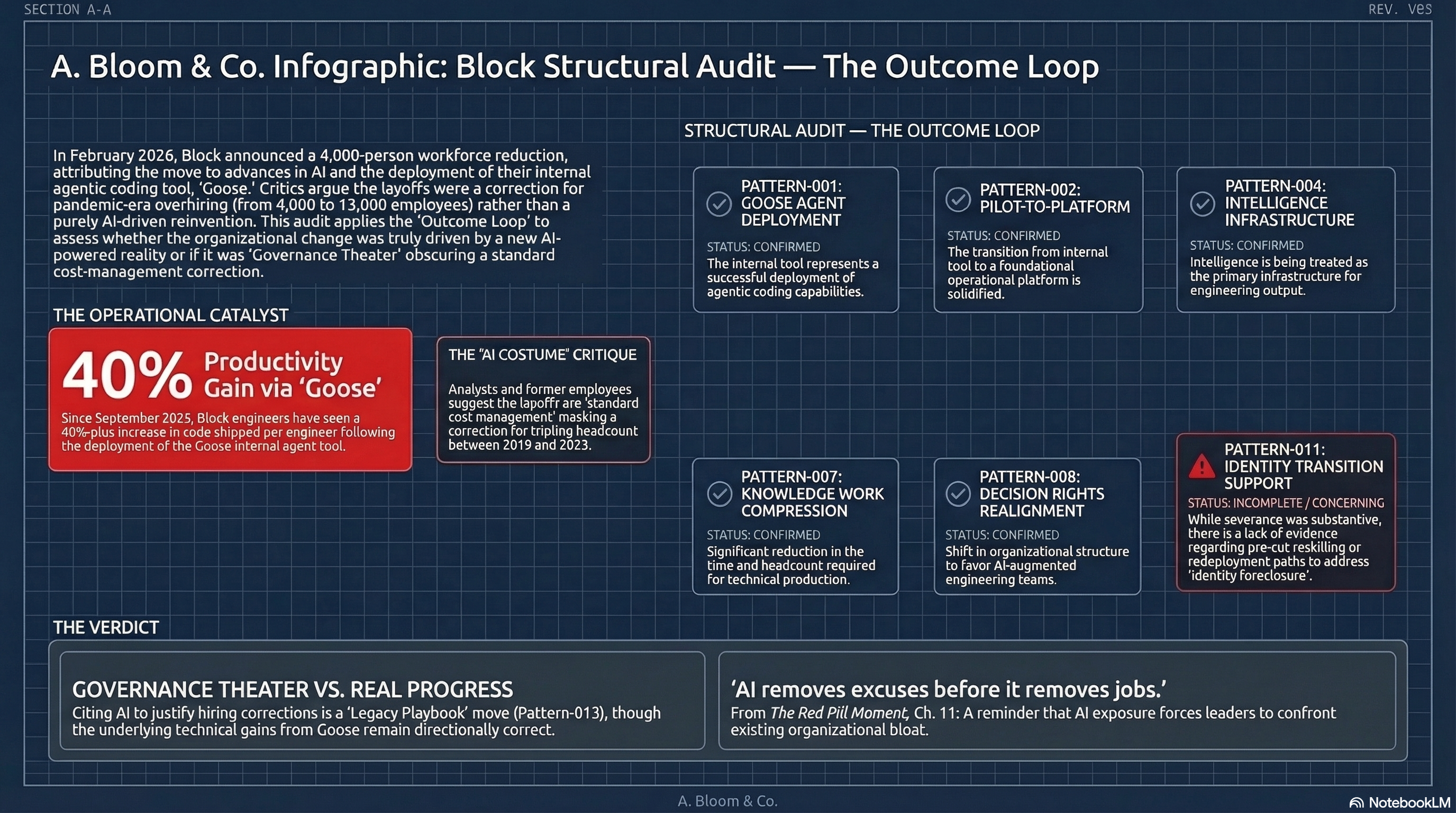
Pattern-001 (AI Agent Deployment + Workforce Reduction): CONFIRMED
- Observable indicators present: Named AI agent publicly deployed (Goose); simultaneous 40% headcount reduction; explicit productivity claims (40% more code per engineer); new roles focused on AI infrastructure; leadership language shifted from “augmentation” to “fundamentally changes what it means to build and run a company”
- Evidence: Q4 2025 earnings call, Dorsey shareholder letter, January 2025 open-source launch
Pattern-002 (Pilot-to-Platform Transition): CONFIRMED
- Observable indicators present: Moved from internal engineering experiment (~12 engineers, early 2024) to enterprise-wide deployment across all functions; creation of MCP as shared infrastructure protocol; contributed to Linux Foundation as foundational infrastructure
- Evidence: Sequoia podcast (September 2025), Linux Foundation AAIF announcement (December 2025), open-source launch (January 2025)
Pattern-004 (Functional Org Restructure to Outcome Teams): CONFIRMED (partial)
- Observable indicators present: CTO explicitly describes “unwinding the GM structure” from business unit silos to functional teams; management layers reduced in 2025 (200 managers demoted); teams described as “smaller and flatter” post-reduction
- Evidence: Sequoia podcast; Q4 earnings call (Dorsey: “We were operating a company with basically two companies inside of it, both having their own structure, a lot of duplication. And as we functionalized, it allowed us to act more like one company.”)
- Caveat: The reorganization was toward functional centralization (not yet outcome-centric teams in the RPM sense), but this was explicitly framed as the organizational precondition for the AI transformation
Pattern-007 (Knowledge Work Role Compression): CONFIRMED
- Observable indicators present: Roles described as eliminated include project managers serving as “translators” between client needs and development tasks, mid-level engineers responsible for interface integration across teams, and coordination/supervision layers; new roles focused on AI infrastructure engineering
- Evidence: OSL reporting on Goose’s capabilities (“project managers who act as translators between client needs and development tasks had their communication functions ruthlessly wiped out”); Q4 earnings call citing compressed engineering headcount alongside 40% productivity gains
Pattern-008 (Intelligence Infrastructure Build-Out): CONFIRMED
- Observable indicators present: Goose built as shared enterprise platform (not departmental tool); MCP as open protocol connecting all enterprise systems; “Recipes” feature for sharing governed workflows across teams; on-premise/VPC deployment model preserving data security for regulated financial company; contributed to Linux Foundation as foundational infrastructure
- Evidence: Block’s open-source launch announcement, Sequoia podcast, VentureBeat interview with CTO and AI tech lead, Linux Foundation AAIF announcement
Pattern-011 (Workforce Preparedness Program): INCOMPLETE / CONCERNING
- Observable indicators present: No publicly disclosed reskilling or redeployment program identified; severance package announced (20 weeks + tenure supplement, 6 months healthcare, devices, $5k); mandatory AI tool adoption already embedded in performance reviews before layoffs
- Evidence: CNN reporting on severance package; Metaintro reporting on employee reaction and mandatory AI adoption; Blind discussion threads confirming severance but no mention of reskilling programs
- Status: The evidence confirms financial transition support but not capability transition support. See Humanitarian Assessment.
Pattern-012 (Copilot-to-Redesign Escalation): CONFIRMED
- Observable indicators present: Dorsey explicitly claims Goose was “the first agentic harness out in the market” — framed as leading with agents, not escalating from copilots; no evidence of prior Microsoft Copilot or similar tool deployment at Block
- Evidence: Q4 earnings call; Sequoia podcast (Prasanna notes Block’s long ML history, but frames generative AI as a distinct capability threshold)
- Interpretation: Block appears to have built natively for agents rather than deploying copilots first, then escalating. This is the “direct to redesign” path, which demonstrates rpm-prin-001 recognition before failure forced it
RPM Principle Mapping
[rpm-prin-001]: The Red Pill Moment
Why this principle applies:
Dorsey’s February 2026 announcement is among the clearest public expressions of this principle in documented corporate history. He did not frame the workforce reduction as an efficiency measure or a response to financial pressure. He framed it as structural acceptance: “Intelligence tools have changed what it means to build and run a company.” He explicitly stated he would rather act on his own terms than be “forced into it reactively.” The decision to reduce headcount by 40% — from a position of financial strength, in a single announced action — is the operational definition of accepting accountability for redesign rather than continuing to manage drift.
Supporting evidence:
- Shareholder letter: “I don’t think we’re early to this realization. I think most companies are late.”
- Q4 earnings call: Dorsey traces the inflection point to December 2025 model capability improvements and connects it directly to the structural decision
- Block’s stock market reaction (+24%) signals that investors read this as a credible structural decision, not cost-cutting theater
From the doctrine:
rpm-prin-001 defines the Red Pill Moment as the point where a leader “stops treating generative AI as an optional technology initiative and accepts it as a permanent structural operating condition.” The governing insight is that AI is not incremental — it collapses performance gradients. Block’s timeline from internal pilot (early 2024) to structural transformation announcement (February 2026) traces exactly the arc the doctrine describes: compounding capability, then a recognition event, then accountability for redesign.
[rpm-prin-004]: The Collapse of Knowledge Work
Why this principle applies:
Block’s Goose deployment documents precisely which categories of cognitive work have been compressed: integration coordination between engineering teams, translation between client requirements and development tasks, code maintenance and migration tasks, supervision and management layers, and routine analytics and reporting. These are roles whose value was cognitive throughput — the exact category the principle names.
Supporting evidence:
- OSL reporting documents specific role categories eliminated: mid-level engineers handling interface integration across microservices, project managers serving as “translators” between clients and development, and operations roles requiring 24/7 supervision coverage (now handled by Goose’s autonomous log analysis and rollback capabilities)
- Q4 earnings data: production code shipped per engineer up 40% since September 2025, while engineering headcount was being reduced — the clearest available data on effort compression
- Dorsey’s Goose description (“an agent… not just code suggestions — it builds entire projects from scratch, writes and executes code, debugs failures, orchestrates workflows, and interacts with external APIs — autonomously”)
From the doctrine:
rpm-prin-004 states that AI “compresses cognitive labor to near-zero cost, severing the historical link between effort, experience, and delivered value.” The principle predicts that “middle management layers built on translation and supervision face the sharpest value erosion.” The specific roles Block eliminated map precisely to this prediction.
[rpm-prin-007]: Intelligence as Infrastructure
Why this principle applies:
Goose is not a departmental tool. It is an enterprise-wide intelligence platform built on a shared protocol (MCP), with shareable workflow scripts (“recipes”), on-premise deployment for data security, and broad interoperability across enterprise systems (GitHub, Jira, Slack, Google Drive, Salesforce, and others). Block then contributed it to the Linux Foundation as foundational infrastructure for the broader AI ecosystem — treating it not as competitive advantage but as shared infrastructure, consistent with how foundational technology layers are treated.
Supporting evidence:
- January 2025 open-source launch under Apache 2.0: “fully Apache licensed… we’re not monetizing Goose directly”
- MCP development in collaboration with Anthropic, now contributed to Linux Foundation AAIF alongside Anthropic’s MCP and OpenAI’s AGENTS.md (December 9, 2025)
- Sequoia podcast: Prasanna describes Goose’s “recipes” feature enabling governed workflow sharing across teams, and Block’s reorganization to centralized functional teams to enable enterprise-wide AI governance
- AI tech lead Bradley Axen on privacy architecture: “We definitely do not have anything in the middle of Goose usage — no calls to our servers… we’re able to bring the models to where the data is already hosted”
From the doctrine:
rpm-prin-007 prescribes that AI must be “treated as a shared foundational layer — like compute or identity — not a project, department, or center of excellence.” Block’s architectural choices — on-premise deployment, open protocol, shareable governance scripts, open-source contribution — are a textbook expression of this principle.
[rpm-prin-012]: From Functions to Outcomes
Why this principle applies:
Dorsey’s explicit description of the organizational problem — “two companies inside of it, both having their own structure, a lot of duplication” — names exactly the functional org problem this principle addresses. The organizational response was “functionalization” (consolidating to unified functional teams, eliminating duplication, reducing management layers) paired with intelligence embedded directly into delivery. The resulting smaller teams are described as faster-moving and more accountable for outcomes than the prior distributed structure.
Supporting evidence:
- Q4 earnings call: Dorsey describes functionalization as the organizational precondition that gave him “confidence in making this move”
- CFO Ahuja’s framing: “move faster with smaller, highly talented teams using AI to automate more work”
- Owen Jennings (Business Lead): “Smaller, more nimble teams allow us to move faster and eliminate organizational overhang”
- Prasanna on Sequoia podcast: describes “unwinding our GM structure” from business unit silos as key to enabling AI adoption — the structural change that made intelligence infrastructure possible
From the doctrine:
rpm-prin-012 names coordination latency — not execution capacity — as the dominant bottleneck under AI. The principle predicts that “functions hit their KPIs while customer outcomes suffer” in unrestructured orgs. Block’s reorganization from duplicated business unit structures to unified functional teams is a direct response to this structural failure.
[rpm-prin-011]: The Human Question
Why this principle applies:
Block’s handling of the workforce impact is the most important and unresolved question in this case study. The principle states that “AI removes excuses before it removes jobs” — when cognition is cheap and execution is fast, leaders can no longer attribute workforce decisions to capacity constraints. Dorsey’s framing confirmed this: he said explicitly the business was strong, that this was not about performance or necessity in the traditional sense, and that “intelligence tools” had changed the calculus. That clarity is itself an RPM-compliant response to the principle. What remains unclear is whether it was accompanied by the preparedness work the principle requires.
Supporting evidence:
- Severance package (as announced): 20 weeks salary + 1 week per year of tenure, equity vested through end of May, 6 months of healthcare, corporate devices, $5,000 transition payment
- Mandatory AI adoption before layoffs: Dorsey required daily AI tool use and embedded it in performance reviews prior to the February 2026 announcement — this could be read as either preparedness or pre-screening
- No publicly disclosed reskilling, redeployment, or internal mobility program identified in any source reviewed
- Employee reports from Metaintro and Blind document high morale damage; one Pressvia account describes an employee terminated while actively conducting a job interview
From the doctrine:
rpm-prin-011 distinguishes between “real preparedness” (training before layoffs, specific transition paths, measurable outcomes) and “theater” (training announced with layoffs, vague programs, no outcome tracking). Block’s severance is financially substantive for the current market. But there is no evidence of capability transition programs, AI literacy preparation for workers who might seek roles elsewhere, or measurable redeployment outcomes. The $5,000 transition payment and six months of healthcare are supports for financial survival, not for navigating the new economy the layoffs were justified by.
Humanitarian Impact Assessment
What the company said:
Dorsey’s February 26, 2026 announcement was notable for what it did not say. Unlike many AI-adjacent layoff announcements, he did not promise reskilling programs, celebrate the employees being let go as “incredible talent who will land on their feet,” or describe AI as a partner rather than a replacement. The framing was direct: intelligence tools have changed what it means to run a company, and a smaller team can now do more. He acknowledged risk. He cited strength, not necessity. And he announced a severance package that, by comparative standards, was generous: 20 weeks of base pay plus tenure supplement, six months of healthcare, equity through May, devices, and $5,000.
What actually happened:
Over 4,000 employees received departure notices on a single day. Reports of employees being locked out of systems mid-task suggest the execution was abrupt rather than phased. The job market that those 4,000 employees entered in early 2026 is, by multiple analyst reports, notably hostile to white-collar tech talent — a job market Dorsey himself helped create the conditions for.
There is no public evidence of:
- A reskilling or AI literacy program for affected employees
- An internal mobility program prioritizing affected workers for new AI-native roles
- A redeployment rate or outcome metric
- Third-party outplacement partnerships (some sources mention outplacement for “certain roles,” but no program details are disclosed)
The mandatory AI adoption mandate that preceded the layoffs is ambiguous in meaning: it could represent genuine organizational preparation for an AI-native future, or it could represent performance screening — identifying who would be replaced by AI by measuring who couldn’t demonstrate productivity with it.
Assessment:
Financially, Block’s transition package exceeds the market baseline and likely represents genuine consideration for affected workers. On the RPM framework, however, financial support is only one component of preparedness. The other components — capability development, honest communication about which roles have no equivalent path forward, and measurable transition outcomes — are not evidenced.
Dorsey’s framing earns points for honesty: he did not obscure the AI rationale, pretend this was about pandemic overhiring correction alone, or offer empty reassurances about new jobs being created. But honesty about the reason for cuts is not the same as building preparedness for the workers cut. rpm-prin-011 asks: “Are we building preparedness, or are we managing optics?” Block’s answer appears to be: “We’re doing neither — we’re just telling the truth and paying people to leave.” That may be the most honest version of what a Red Pill transition looks like at scale. It is not, by the doctrine’s standard, sufficient.
Key questions answered:
- Were employees given honest timelines and transition paths? Honest framing; no specific transition paths disclosed.
- Was training/reskilling provided before or after role eliminations? AI fluency was required before layoffs; no reskilling for the post-employment period identified.
- Are there measurable outcomes for transition success? No public disclosure.
- Did leadership take public accountability for workforce impact? Dorsey took accountability for the decision and its rationale, but not for the workforce transition outcomes.
Key Lessons
What Block got right:
- Built intelligence infrastructure (Goose) before announcing transformation — the productivity evidence preceded the headcount decision, not the reverse
- Made the organizational structural change (functionalization) that enabled enterprise-wide AI adoption, rather than deploying AI on top of broken structures
- Open-sourced Goose and contributed to open standards (MCP, AAIF) — treating intelligence as infrastructure rather than hoarding it as competitive advantage
- Announced all cuts in a single action with transparent rationale, rather than the “death by a thousand cuts” approach that Dorsey himself identifies as more destructive to trust and culture
- Provided a severance package that was financially substantive by market standards
What remains unclear or concerning:
- No public evidence of a capability transition program for affected workers entering a hostile job market — financial support without career support is incomplete by RPM standards
- The compliance and operational risk of running heavily regulated fintech (Cash App, Square, lending operations) at 40% reduced headcount with AI handling more decisions has not been publicly stress-tested
- The mandatory AI adoption policy, while described as preparation, may have been experienced by employees primarily as surveillance and screening — the distinction between building capability and measuring replaceability is not yet clear from available evidence
- Whether the organizational restructure achieved true outcome-centric teams (rpm-prin-012) or merely centralized functional silos — the doctrine’s standard requires ownership of complete loops, not just functional consolidation
Implications for other organizations:
- Goose’s two-year internal deployment before the structural decision is the critical sequence: Block had real productivity evidence before it made structural claims. Companies that cite AI to justify cuts without documented, longitudinal productivity data are “AI washing” in the analytical sense even if not the intentional sense
- The organizational precondition matters: Prasanna’s “unwinding of the GM structure” was identified as the precondition for AI adoption, not a consequence of it. Organizations that try to deploy enterprise AI on top of duplicated, siloed structures will hit the limits the doctrine predicts
- The December 2025 model capability inflection point Dorsey cites is worth taking seriously — if leadership has not built the infrastructure to exploit step-changes in model capability as they occur, they will be perpetually reactive
- The humanitarian question is unresolved: Block’s approach suggests “generous severance + honest framing” may be the floor the market settles on. The doctrine argues this is insufficient. Organizations watching Block will need to decide whether they intend to meet the floor or set a higher standard
Sources
- American Banker — “Block replacing 40% of its staff with AI,” February 28, 2026. https://www.americanbanker.com/payments/news/block-replacing-40-of-its-staff-with-ai
- American Banker — “Is Block the first domino for AI-spurred layoffs?” March 3, 2026. https://www.americanbanker.com/payments/news/is-block-the-first-domino-for-ai-spurred-layoffs
- Block, Inc. — “Block Open Source Introduces ‘codename goose’ — an Open Framework for AI Agents,” January 28, 2025. https://block.xyz/inside/block-open-source-introduces-codename-goose
- CNBC — “Block shares soar as much as 24% as company slashes workforce by nearly half,” February 26, 2026. https://www.cnbc.com/2026/02/26/block-laying-off-about-4000-employees-nearly-half-of-its-workforce.html
- CNN Business — “Block lays off nearly half its staff because of AI,” February 26, 2026. https://www.cnn.com/2026/02/26/business/block-layoffs-ai-jack-dorsey
- Fortune — “Block CEO Jack Dorsey lays off nearly half of his staff because of AI,” February 27, 2026. https://fortune.com/2026/02/27/block-jack-dorsey-ceo-xyz-stock-square-4000-ai-layoffs/
- FunderIntel — “Block Layoffs: Jack Dorsey Cuts 4,000 Jobs & AI Is Why,” February 28, 2026. https://www.funderintel.com/post/block-layoffs-jack-dorsey-cuts-4-000-jobs-ai-is-why
- Inference by Sequoia Capital (Substack) — “Block CTO Dhanji Prasanna: Building the AI-First Enterprise with Goose,” September 30, 2025. https://inferencebysequoia.substack.com/p/block-cto-dhanji-prasanna-building
- Lambda Ham — “Block Open-Sources Goose AI Agent Built with Anthropic,” November 9, 2025 (documenting initial internal deployment data). https://www.lambham.com/post/block-s-ai-strategy
- Lenny’s Newsletter — “How Block is becoming the most AI-native enterprise in the world,” October 26, 2025. https://www.lennysnewsletter.com/p/how-block-is-becoming-the-most-ai-native
- Linux Foundation — “Linux Foundation Announces the Formation of the Agentic AI Foundation,” December 9, 2025. https://www.linuxfoundation.org/press/linux-foundation-announces-the-formation-of-the-agentic-ai-foundation
- Metaintro — “Jack Dorsey Block Layoffs AI Mandates Employee Backlash 2026,” March 1, 2026. https://www.metaintro.com/blog/jack-dorsey-block-layoffs-ai-mandates-employee-backlash-2026
- Motley Fool — “Block (XYZ) Q4 2025 Earnings Call Transcript,” February 27, 2026. https://www.fool.com/earnings/call-transcripts/2026/02/27/block-xyz-q4-2025-earnings-call-transcript/
- OSL — “Block Cuts 50% Staff: AI Goose & Efficiency,” March 2026. https://www.osl.com/hk-en/bits/article/block-cuts-50-percent-staff-ai-goose-efficiency
- Pressvia — “Jack Dorsey guts Block workforce to build AI first giant,” February 28, 2026. https://www.pressvia.com/category/business-startups/block-jack-dorsey-ai-layoffs-2026
- Radical Compliance — “The Question That Block’s Layoffs Poses,” February 27, 2026. https://www.radicalcompliance.com/2026/02/27/the-question-that-blocks-layoffs-poses/
- Sequoia Capital (Training Data podcast) — “Block’s Prasanna: The Open Source Goose Transformation,” September 30, 2025. https://sequoiacap.com/podcast/training-data-dhanji-prasanna/
- Startuphub.ai — “Block’s AI Blueprint: From Open-Source Agents to Organizational Overhaul,” September 30, 2025. https://www.startuphub.ai/ai-news/ai-video/2025/blocks-ai-blueprint-from-open-source-agents-to-organizational-overhaul/
- TechCrunch — “Jack Dorsey just halved the size of Block’s employee base — and he says your company is next,” February 26, 2026. https://techcrunch.com/2026/02/26/jack-dorsey-block-layoffs-4000-halved-employees-your-company-is-next/
- VentureBeat — “Jack Dorsey is back with Goose, a new, ultra-simple open-source AI agent-building platform,” January 28, 2025 (updated December 22, 2025). https://venturebeat.com/programming-development/jack-dorsey-is-back-with-goose
Note: This case study is based on publicly available information as of March 4, 2026. Block may have additional non-public transition programs, governance architectures, or organizational details not captured in public sources. The humanitarian assessment in particular may be incomplete; it reflects the absence of disclosed programs rather than confirmed absence of programs.
Patterns confirmed: pattern-001, pattern-002, pattern-004 (partial), pattern-007, pattern-008, pattern-012
Patterns unconfirmed (insufficient public evidence): pattern-003, pattern-006, pattern-009, pattern-010
Patterns present but incomplete: pattern-011
RPM Principles demonstrated: rpm-prin-001, rpm-prin-004, rpm-prin-007, rpm-prin-011 (unresolved), rpm-prin-012
 A.Bloom & Co.