 The Generative Sales & Marketing Organization
Chapter 2
University Professor Hat On

Reading guide
What does the book’s illustration experiment have to do with business writing?
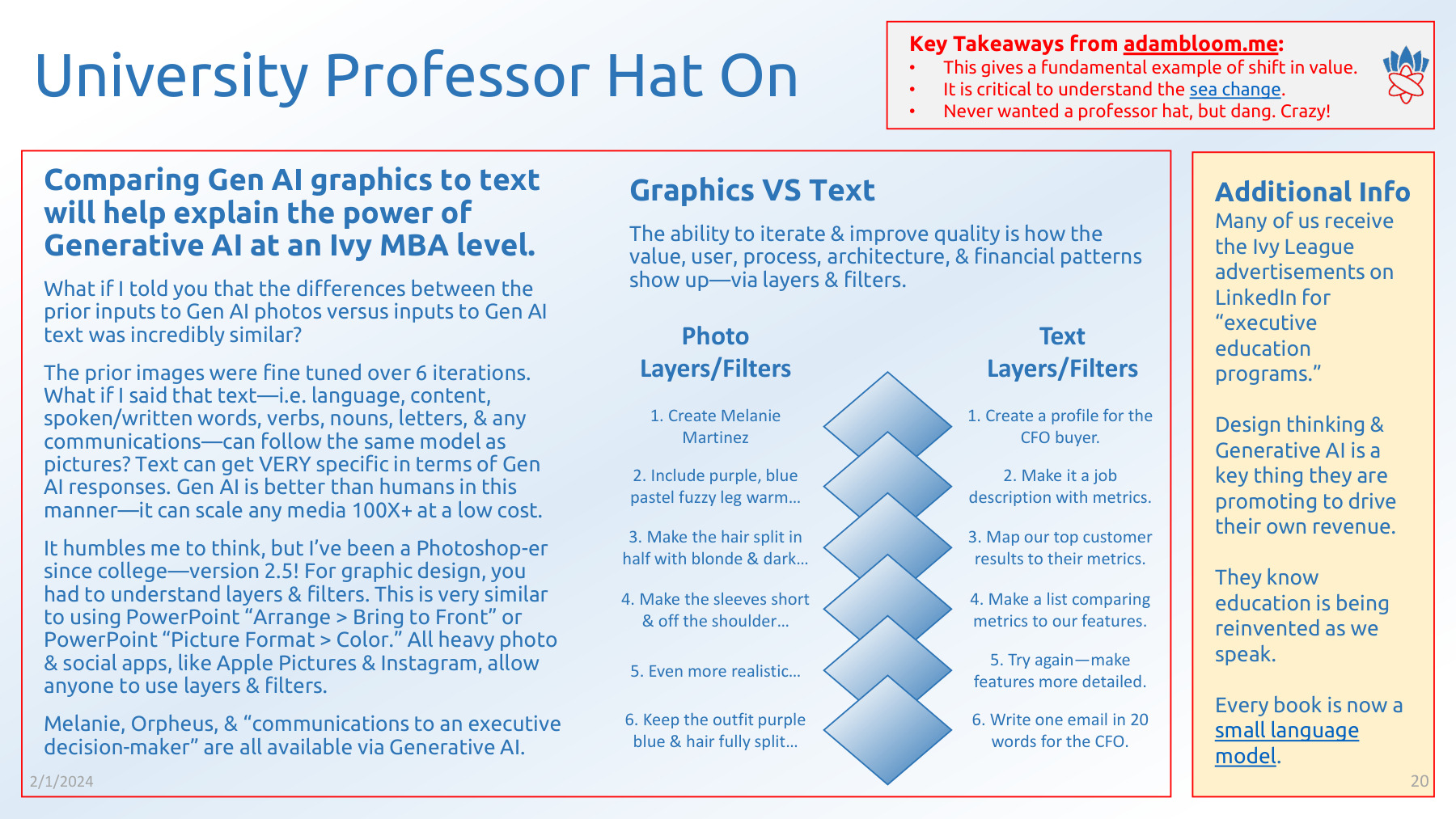
Adam compares six rounds of refining an illustration with six steps for creating a short email to a CFO. Both examples start with a broad request and use successive instructions to make the result more specific.
Simplified graphic
Two workflows, refined in stages
1–2. Set the brief
Start with a character and costume details for the image. For the text, start with a CFO buyer profile, then specify a job description and its metrics.
3–4. Add specifics
Refine the hair and sleeve details. For the CFO, map customer results to those metrics and compare the metrics with product features.
5–6. Refine and deliver
Revise the image for realism, color, and hair. Refine the feature comparison, then write a 20-word email for the CFO.
Editorial visual
The same approach can refine a picture or a business message.
The original diagram calls the successive instructions layers or filters, borrowing a familiar idea from graphic design.
What the graphic compares
The left side looks back at the six illustration rounds. The right side starts with a CFO buyer profile, moves through the role’s metrics and product relevance, and ends with one email in 20 words.
Why Adam uses layers and filters
He compares iterative prompting with adjusting layers in Photoshop or arranging objects and changing colors in PowerPoint. He presents the parallel as an example of how generative AI could change the economics of producing both graphics and text.