 The Generative Sales & Marketing Organization
Chapter 3
Example Gen AI Use Cases

Reading guide
What kinds of generative AI use cases does the book list?
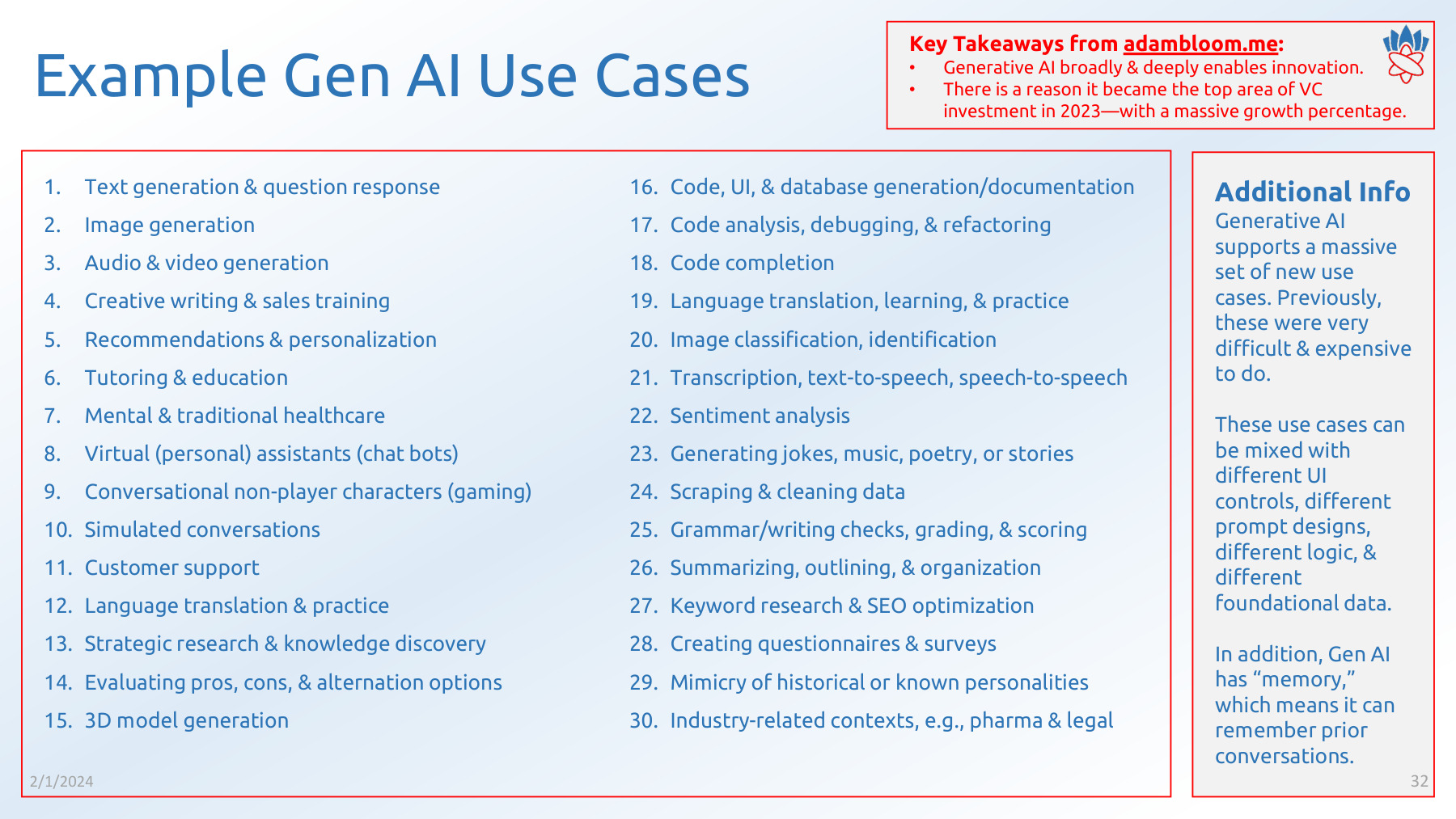
The book lists 30 examples, spanning text, images, audio and video, education, customer support, research, software, and industry-specific work. Its sidebar describes combining these uses with different interfaces, prompts, logic, and source data.
Simplified graphic
Examples grouped by what they help people do
Create and communicate
Generate text, images, audio, video, 3D models, stories, music, sales training, and translations.
Interact and learn
Use assistants, tutoring, simulated conversations, game characters, language practice, and customer support.
Develop and analyze
Generate or document code, interfaces, and databases. Analyze, debug, refactor, complete code, and classify images.
Research and organize
Discover knowledge, weigh options, clean data, summarize, score writing, analyze sentiment, research keywords, and create surveys.
Adapt to a domain
The book includes healthcare, legal and pharmaceutical contexts, personalization, speech tools, and imitations of known personalities.
Editorial visual
Use cases can be combined.
The page pairs its list with several ways to adapt a use case, including interfaces, prompts, logic, and source data.
How to use the list
The book places both broad tasks, such as text generation, and specific tasks, such as grading, keyword research, and code completion, in the same inventory.
Context changes the result
The sidebar describes combining use cases with different controls and foundational data. It also points to systems that can use prior conversation context.