>> Click to Download Book PDF <<
^^^^^^ Or go to home page ^^^^^^
FOR IMMEDIATE RELEASE
As Anthropic “Plug-in-izes” Knowledge Work, Adam Bloom Releases The Red Pill Moment – How Leaders Win: Changing Perception in the Age of AI -> Helping Executives Decide What To Do Next
FOR IMMEDIATE RELEASE
SCROLL DOWN TO READ THE BOOK
As Anthropic “Pluginizes” Knowledge Work with Claude Code / Cowork Plugins, Adam Bloom Releases The Red Pill Moment v2.2 –Helping Executives Decide What to do Next
Greenville, South Carolina — February 05, 2026
News Highlights
- What happened: Anthropic introduced role-based plugins for its Claude agent stack (Cowork / compatible with Claude Code), spanning functions like customer service, product, marketing, legal, and data analysis. (TechCrunch)
- What it signals: “AI adoption” is no longer a roadmap item—work itself is becoming installable, reusable, and rapidly deployable across teams. (TechCrunch)
- What Bloom is releasing: After writing “The Generative Sales and Marketing Organization” in February of 2024), Bloom releases The Red Pill Moment – How Leaders Win: Changing Perception in the Age of AI (v2.2) — a free executive field guide focused on decision rights, auditability, accountability, and trust when AI becomes a production layer.
- Download the book: [https://adambloom.me/wp-content/uploads/2026/01/the-red-pill-moment-how-leaders-wine28094changing-perception-in-the-age-of-ai-v2.2_compressed-1.pdf]
[Greenville, 2026] — Adam Bloom today announced the release of The Red Pill Moment – How Leaders Win: Changing Perception in the Age of AI (v2.2), positioning it alongside a clear market signal: Anthropic’s new Claude Code / Cowork plugins package specialized “knowledge work” into installable bundles designed to automate or accelerate tasks across core business functions. (TechCrunch)
Anthropic says the new plugins can automate work such as drafting customer support responses, preparing for sales calls, researching prospects, assessing NDAs, reviewing contracts and legal briefings, and building financial models and statements—turning previously bespoke professional workflows into repeatable execution components. (LinkedIn)
Quotes (Adam Bloom):
“Cheap intelligence makes old management expensive. The economics are clear.” —adambloom.me
“Traditional management assumed thinking was expensive and execution was cheap. AI flips this. Now execution is fast and cheap, but coordination and judgment become the scarce resources.” —adambloom.me
“Instead of managers approving work before it happens, leaders should build systems with provenance, logging, and exception handling. Trust scales through traceability, not permission. —adambloom.me
“Define clear contracts and boundaries between teams/systems, measure what matters, and let execution happen without constant oversight.” —adambloom.me
“Reorganize around measurable outcomes rather than departmental functions. Teams should own the full loop: inputs → action → measurement → correction.” —adambloom.me
“Routine decisions get automated; humans focus on edge cases, high-stakes judgment, and situations where speed and trust collide.” —adambloom.me
What vendors are shipping vs. what executives must ship
What vendors are shipping (capability)
- Role-specific plugin bundles that standardize how Claude performs work in key functions (reworked.co)
- Open, reusable packages (with an open-source plugin library) that teams can customize and share (GitHub)
- Faster intent-to-execution cycles that compress planning, drafting, analysis, and decision prep (SiliconANGLE)
What executives must ship (operating doctrine)
- Decision rights: who owns outcomes when AI produces “first draft” work at scale
- Auditability: traceability, logging, evaluation, and replayable decisions (not permission-based review)
- Exception handling: humans as escalation paths for edge cases and high-stakes judgment
- Trust design: the controls and incentives that make speed non-destructive
What The Red Pill Moment v2.2 helps executives act on immediately
Executive actions
- Make the workstream explicit, then close the loop: build outcome teams that own the full cycle — inputs → action → measurement → correction.
- Replace supervision with auditability: shift control from pre-approval to traceability — build provenance, logging, evaluation, and exception handling as leadership responsibilities.
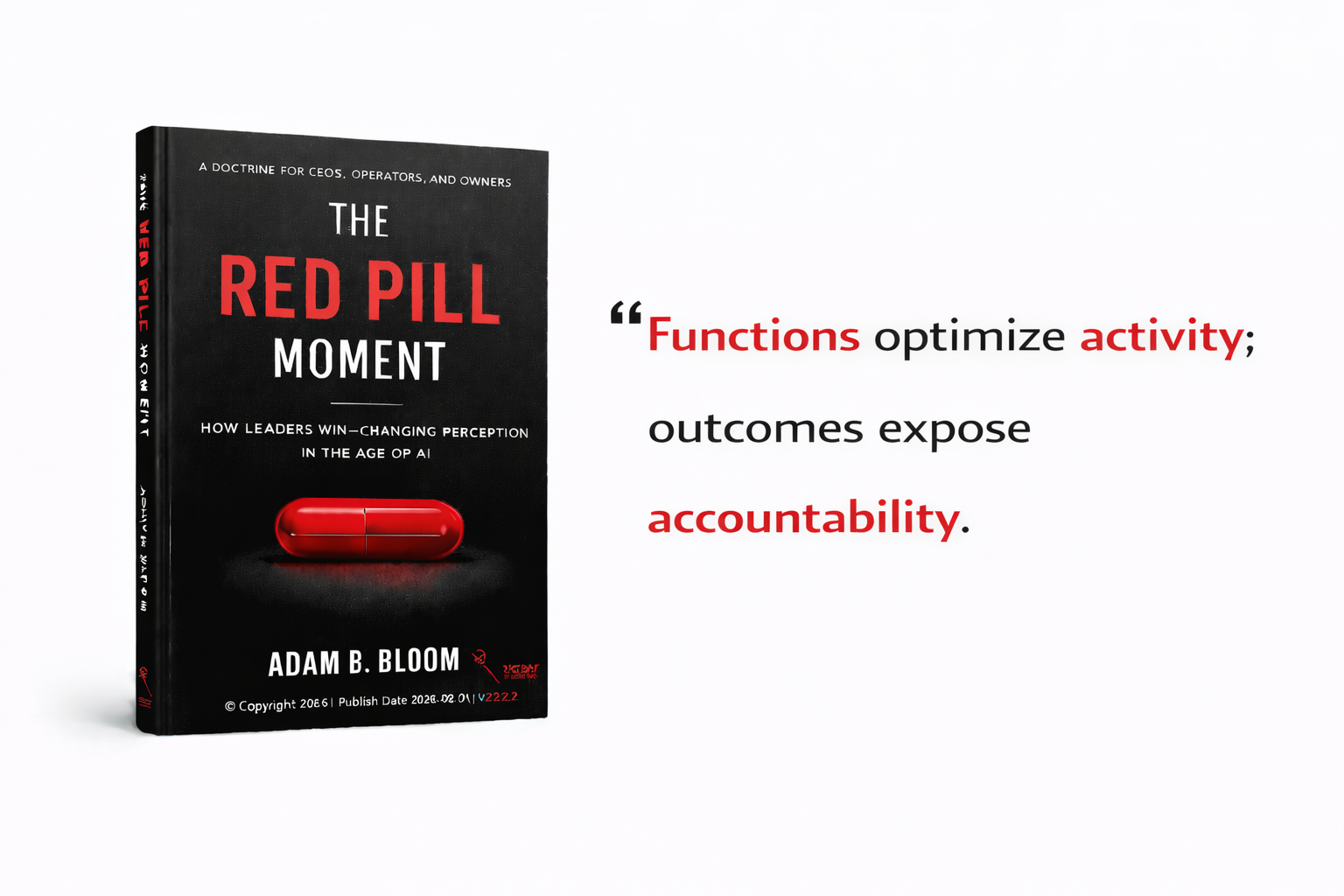
- Shift from functions to outcomes: move from functional ownership to outcome-centric teams that own measurable outputs end-to-end.
- Govern through interfaces, metrics, and decision rights—not hierarchy: define boundaries/contracts and measure what matters, because coordination becomes the bottleneck.
- Reserve human judgment for exception handling: shift humans from routine approval to escalation paths when speed and trust collide.
Availability
The Red Pill Moment – How Leaders Win: Changing Perception in the Age of AI (v2.2) is available for free download at: [The Red Pill Moment – How Leaders Win—Changing Perception in the Age of AI v2.2]
Resources (for media)
- Book PDF (v2.2): [https://adambloom.me/wp-content/uploads/2026/01/the-red-pill-moment-how-leaders-wine28094changing-perception-in-the-age-of-ai-v2.2_compressed-1.pdf]
- 1-page executive summary: [Below]
- Cover image + author headshot: [below]
- Speaker one-sheet / podcast topics: [below]
Media Contact
Adam Bloom
hi@adambloom.me
About the Author
Adam Bloom is an operator, advisor, and investor focused on AI-era leadership, operations, and reshaping real estate with AI. He began working in the AI industry in 2012 and has over 25 years launching high-growth software products for the customer experience industry. Bloom is also a musician, YouTuber, and thankful dude.
Book: Executive Summary
The Red Pill Moment — How Leaders Win: Changing Perception in the Age of AI — Adam Bloom | v2.2
The Shift
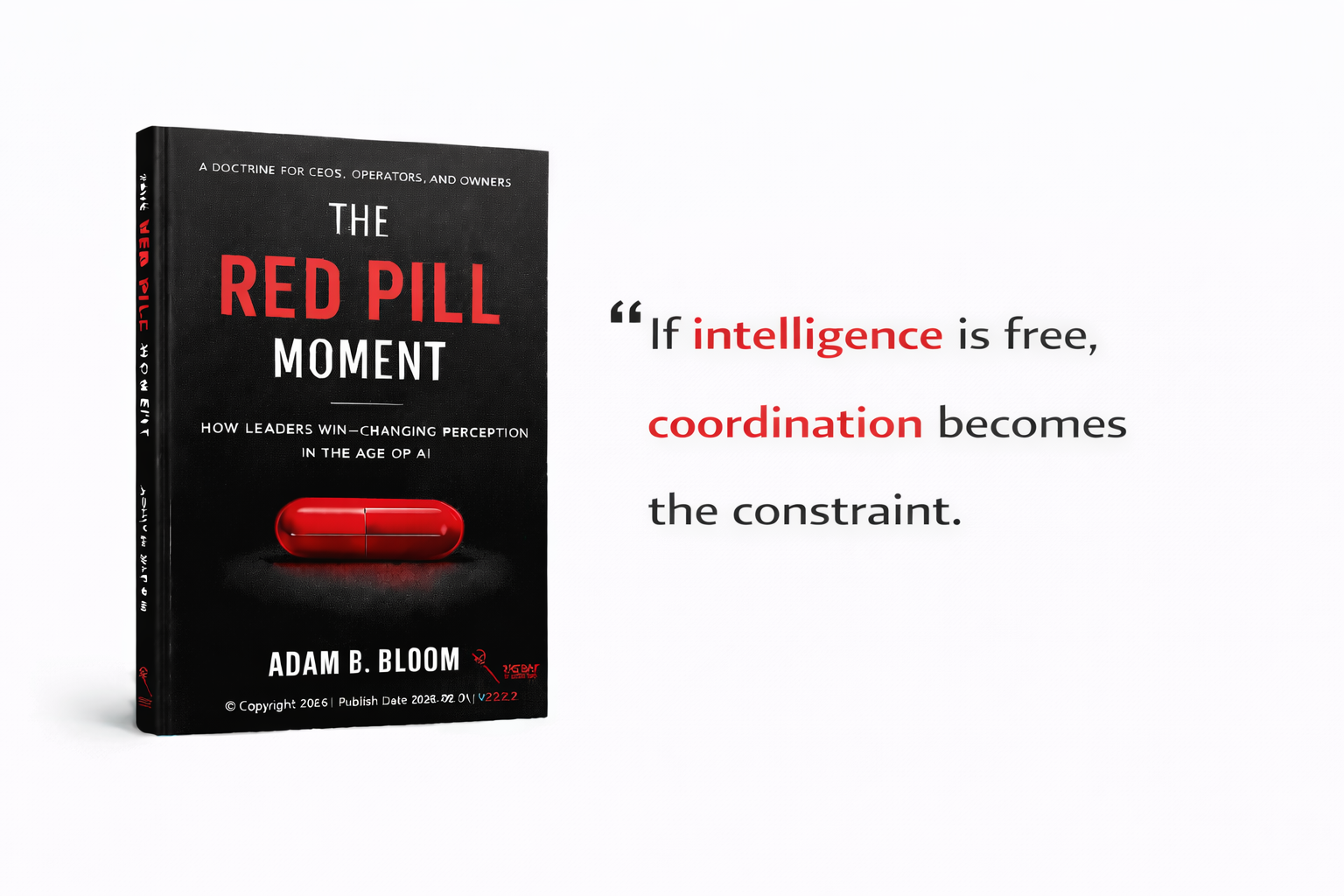
AI has inverted the economics of knowledge work. Intelligence is now cheap and abundant. Execution is fast. The bottleneck has shifted from individual productivity to coordination, decision rights, and trust design.
| “Cheap intelligence makes old management expensive.” — Adam Bloom |
Core Thesis
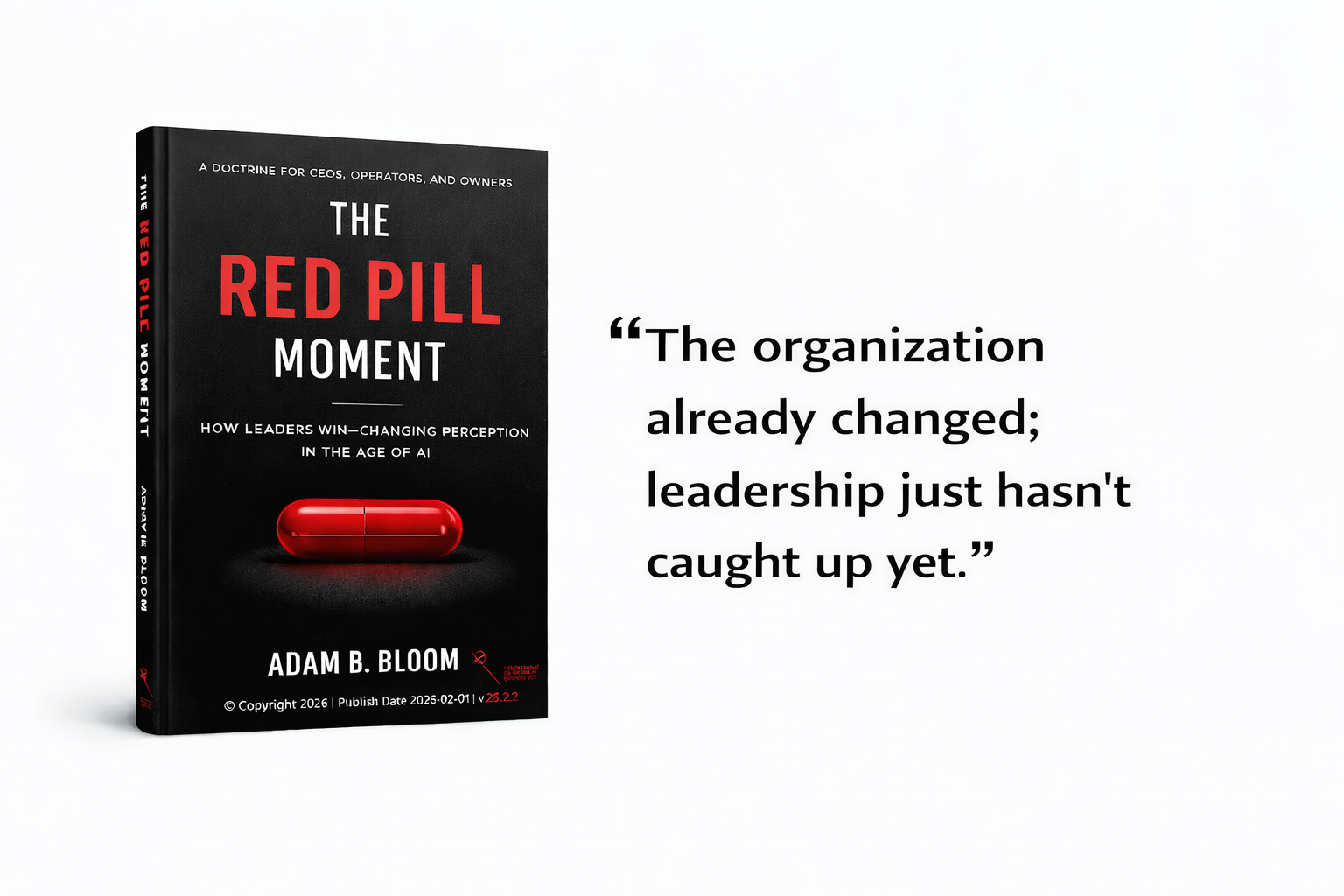
Leaders who cling to supervision-based management will be outpaced by those who redesign how work flows. The question is no longer “how do we adopt AI?” but “how do we govern work when AI produces first-draft outputs at scale?”
Five Actions for Executives
- Make the workstream explicit, then close the loop. Build outcome teams that own the full cycle: inputs → action → measurement → correction.
- Replace supervision with auditability. Shift control from pre-approval to traceability. Provenance, logging, evaluation, and exception handling become leadership responsibilities.
- Shift from functions to outcomes. Move from functional silos to outcome-centric teams that own measurable outputs end-to-end.
- Govern through interfaces, metrics, and decision rights. Define boundaries and contracts. Measure what matters. Coordination becomes the bottleneck—not hierarchy.
- Reserve human judgment for exception handling. Shift humans from routine approval to escalation paths—where speed and trust collide.
The Operating Doctrine
| What Vendors Ship | What Executives Must Ship |
| Role-specific plugin bundles Open, reusable packages Faster intent-to-execution cycles | Decision rights Auditability infrastructure Exception handling protocols Trust design |
The Bottom Line: Intelligence is cheap. Execution is fast. Coordination is the constraint. Trust doesn’t scale by approval—it scales by auditability.
Download the full book: The Red Pill Moment – How Leaders Win—Changing Perception in the Age of AI v2.2
Author Headshot and Cover Image
Right click to download.

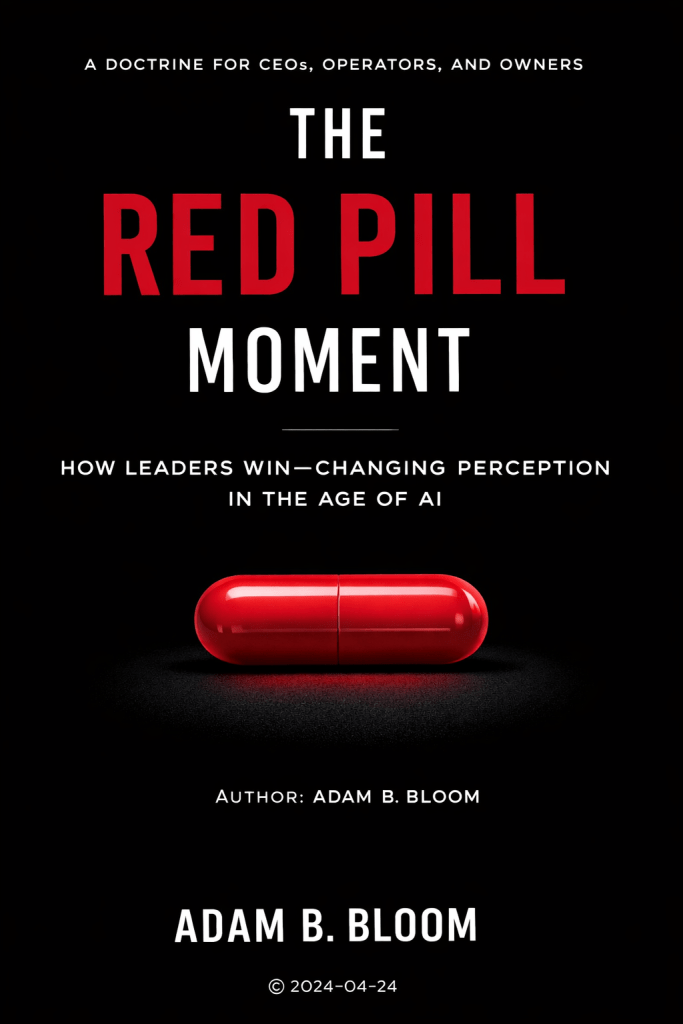
>> Click Book Cover Image Below to Download <<
Speaker One-Sheet & Podcast Topics
Bio
Adam Bloom is a 25+ year business operator and advisor focused on AI-era leadership, operating models, and enterprise go-to-market execution. He has been active in the AI industry since 2012. His book, The Red Pill Moment — How Leaders Win: Changing Perception in the Age of AI, provides executives with a practical framework for governing work when AI becomes a production layer.
After experiencing “being automated by AI” in his prior job, Bloom wrote “The Generative Sales and Marketing Organization” in February of 2024 The impact of AI was felt first hand, two years ago. Now, Bloom dives deep into how leaders must change their perception of business models and incorporates a strong stance. He highlights how executives must consider the human obligation and how leaders must understand that dignity requires agency.
Core Messages
“Cheap intelligence makes old management expensive. The economics are clear.” —adambloom.me
“Traditional management assumed thinking was expensive and execution was cheap. AI flips this. Now execution is fast and cheap, but coordination and judgment become the scarce resources.” —adambloom.me
“The human obligation remains. Preparedness replaces optimism. Dignity requires agency, and agency requires honest systems people can understand, influence, and trust. Leaders do not get to outsource the consequences of acceleration to tools, vendors, or inevitability narratives. Designing the system is the work—and owning its impact is the responsibility.”
Podcast & Interview Topics
- The Red Pill Moment: Choosing to See Clearly Why most leaders are still operating with pre-AI assumptions—and what it takes to recognize the fundamental shift happening in knowledge work.
- The Shift: From Scarcity to Abundant Intelligence How AI has changed the economics of thinking—and why organizations built for scarce cognition are now structurally misaligned.
- The Inversion: Why Cheap Intelligence Makes Old Management Expensive The counterintuitive reality that traditional supervision and approval workflows now cost more than the work they govern.
- The Bottleneck: Coordination as the New Constraint When execution becomes fast and cheap, what actually slows organizations down? The surprising answer: how teams connect, not how individuals perform.
- Decision Rights: Who Owns Outcomes When AI Produces First-Draft Work? The accountability vacuum emerging in AI-augmented workflows—and how leaders must redesign ownership before it becomes a crisis.
- Humans as Exception Handlers: Rethinking Where People Add Value Moving humans from routine approval to escalation paths—where speed and trust collide, and judgment actually matters.
Additional Media
 A.Bloom & Co. | © 2026