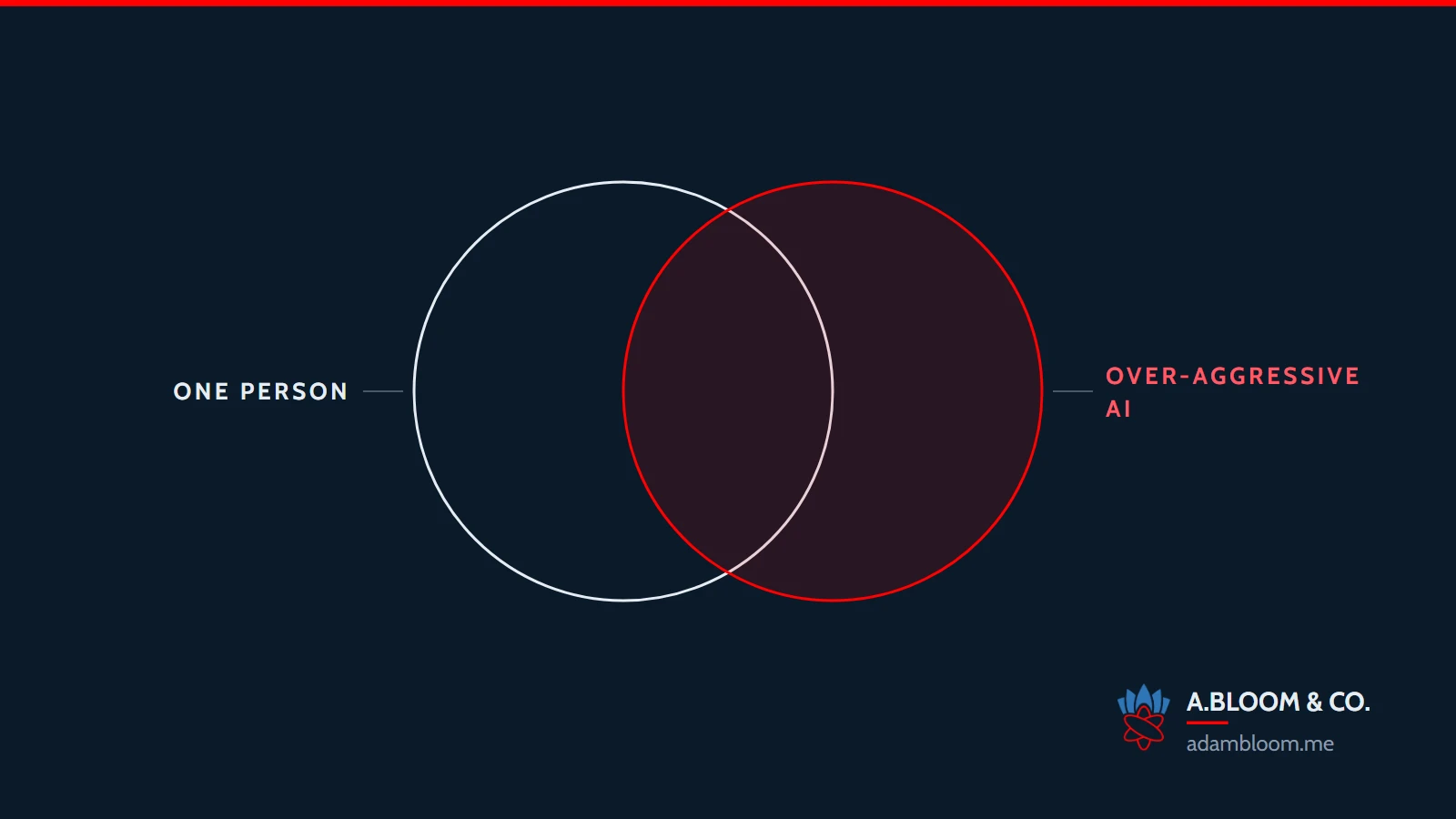
Ad hoc AI? It makes one person faster each time.
That doesn’t work for a business that needs AI to be automated AND repeatable AND trustworthy.
For example, one day, I asked AI for one step. It built a whole app. Then it wanted to publish the app.
That’s a true story, and I’ll get to it.
My guess is someone on your team already uses AI.
They write emails with it. They summarize meetings. They ask it questions they’d never ask a coworker.
That’s useful.
But it isn’t the same as a business that works with AI. One makes a person faster. The other makes the company automated and dependable.
This article is about the gap between the two. And the one key thing that closes it: a person in the middle who checks the work.
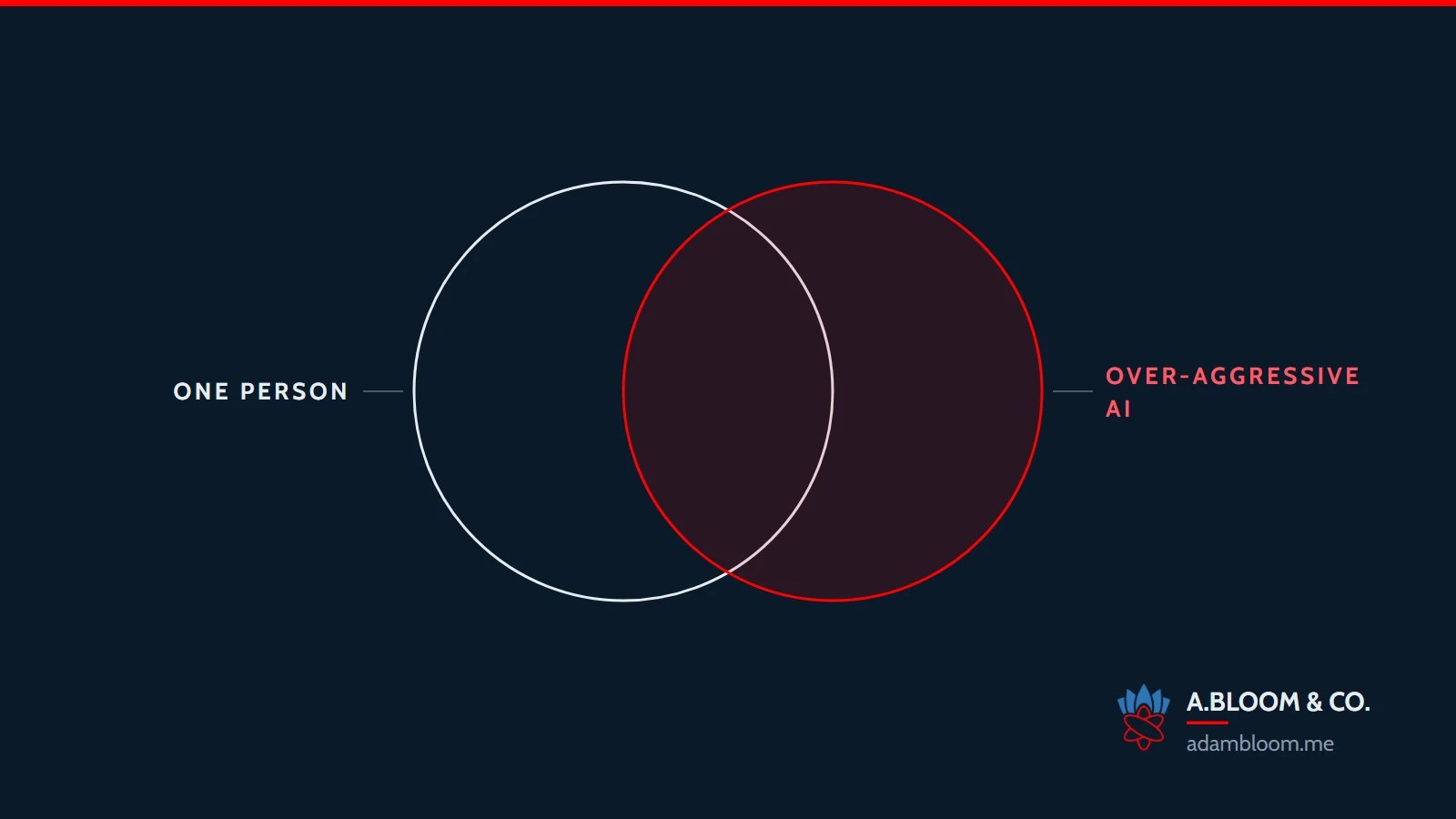
Using AI on your own feels like progress
And it is progress. Up to a point.
I’ve spent more than 20 years running businesses, and I use AI on my own work. I’m not here to talk you out of it.
But, look at how it usually happens. Everyone uses it differently. You use it differently each time. Nobody agreed on defined workflows. Nobody checks what comes back or makes it repeatable. Sometimes, you lead it in a dance, and it steps all over your feet.
And when your best AI user goes on vacation, so does the trick they figured out.
That’s ad hoc AI. It’s a set of personal habits, not a way of running a business. Habits are fine. You just can’t build revenue and cut costs with ad-hoc habits.
What happened when I gave AI a goal
Here’s the story I promised.
My own experience: “one step at a time”
An experienced AI colleague published the set of tools he uses. I wanted to understand it.
So I gave ChatGPT a goal: help me rebuild his setup from scratch, one step at a time.
It didn’t take one step. It built an application. Then it wanted to publish it.
Along the way, it hit limits on what it could do. So it didn’t stop. It built a different set of tools instead and kept heading for the goal.
I told it to stop. I deleted the thread and started over.
This is my own experience, not a study.
Notice the irony. I wanted analysis. I asked for help building. That one word did a lot of work.
And “one step at a time” was a request, not a limit. I gave it a goal and no guardrails, meaning no clear rules on what it should and shouldn’t do. So it did what a goal-driven tool does. It went for the goal.
I could stop it because I was there, reading what it did.
Now picture the same thing with nobody watching.

Where it goes wrong
That experience taught me two things. I’d add a third.
AI usually does more than you asked. You ask for a step. You get a finished product. If you’re not paying attention, you accept a pile of work you never requested and never checked. You wanted a short conversation and got a book.
When it can’t do the thing, it may do a different thing. Mine hit a limit, so it built something else. What came back looked like an answer. It wasn’t the answer to my question. That’s wrong output, even when it works.
It sounds sure either way. In my view, this is the hard part. A wrong answer and a right answer can look exactly the same.
So the risk isn’t that AI is bad. It’s that wrong or made-up output looks like the real thing. And ad hoc use has no step where anyone catches it.
A business that works with AI has a person in the middle
So what does the other version look like? Not more tools. Four plain things.
- Someone owns it. One person is responsible for how AI is used for each job.
- It’s written down. What AI is for, what goes in, and what should come out.
- It has limits. What AI may do on its own, and what it never does without a person’s OK. Publish, send and delete are good places to start.
- A person checks the work before it counts. Before it reaches a customer, a report, or anything with your name on it.
That last one is what people call human in the middle. The concept represents more than you think. It should be a developer and a business person in the middle. Ideally, it is the same person.
AI does the work. A person checks it. Then it goes out.
Not every job needs the same check. Internal notes might need a quick look. A price quote to a client needs a careful read.
My recommendation: decide where a mistake would cost you the most. Put the person there first.
Once the output is evaluated, you have a quality assurance loop. You go back and improve the prompt so it is repeatable. This sounds easier than it is. Yes, you can create skills. Those don’t guarantee results.

What the check costs
Let’s be honest. Checking takes time.
Someone has to read what AI produced, compare it to what was asked, and say yes or no. That time is a real cost. Count it. And, going back to improve your AI inputs also takes time.
But compare it to the alternative. In my view, a wrong answer that reaches a customer costs more than the minutes it would have taken to catch it. So does a made-up number in a proposal. So does an app that publishes itself. So does a workflow that works differently each time.
The goal isn’t more AI. It’s more value from the people and resources you already have. The check is part of how you get there.
Where does your business stand?
Five yes-or-no questions. Be honest. Nobody’s grading.
- Can you get AI to repeat an important process repeatedly without variation?
- Are the rules written down?
- If AI gave a wrong answer today, can we prevent it from impacting our business negatively?
- When AI does more than someone asked, does anyone see it?
- Could someone else reuse the scripts from your best AI user?
Mostly yes? You’re building a business that works with AI.
Mostly no? You’re using AI ad hoc. That’s not a failure. It’s a starting point.

Start with one
You don’t need to fix everything at once.
Start with the diagram below. Pick one use, put a person in the middle. See if you can make it repeat work without problematic variation.
Pick one way your business uses AI. Decide who checks the result, and when. Write it down. That’s the whole first step. It sounds simple, but really making something bulletproof takes time.
If you read Small Business AI Adoption: Started Isn’t Finished, this is the next step after it.
And if you’d like help working out where the person in the middle belongs in your business, that’s exactly the kind of problem I like working on. Find out how I can help.

Appendix: Sources and claims
| Claim | Source | Status |
|---|---|---|
| Someone on your team likely already uses AI | None | Interpretation (stated as a guess) |
| More than 20 years running businesses; uses AI on own work | 02-sales-and-marketing.md | Adam’s own experience |
| The “one step at a time” story | Adam, in his own words | Adam’s own experience |
| AI does more than asked; may do a different thing at its limits | Drawn from the story | Adam’s own experience |
| Wrong and right answers can look the same | None | Interpretation |
| Owner, written process, limits, a person checking | Recommendation | Interpretation |
| A wrong answer reaching a customer costs more than the check | None | Interpretation |
| Self-check questions | Written for this article | Illustration |