I feel junior again
I build knowledge bases. I keep one for every part of my business. Lately, one of them keeps humbling me.
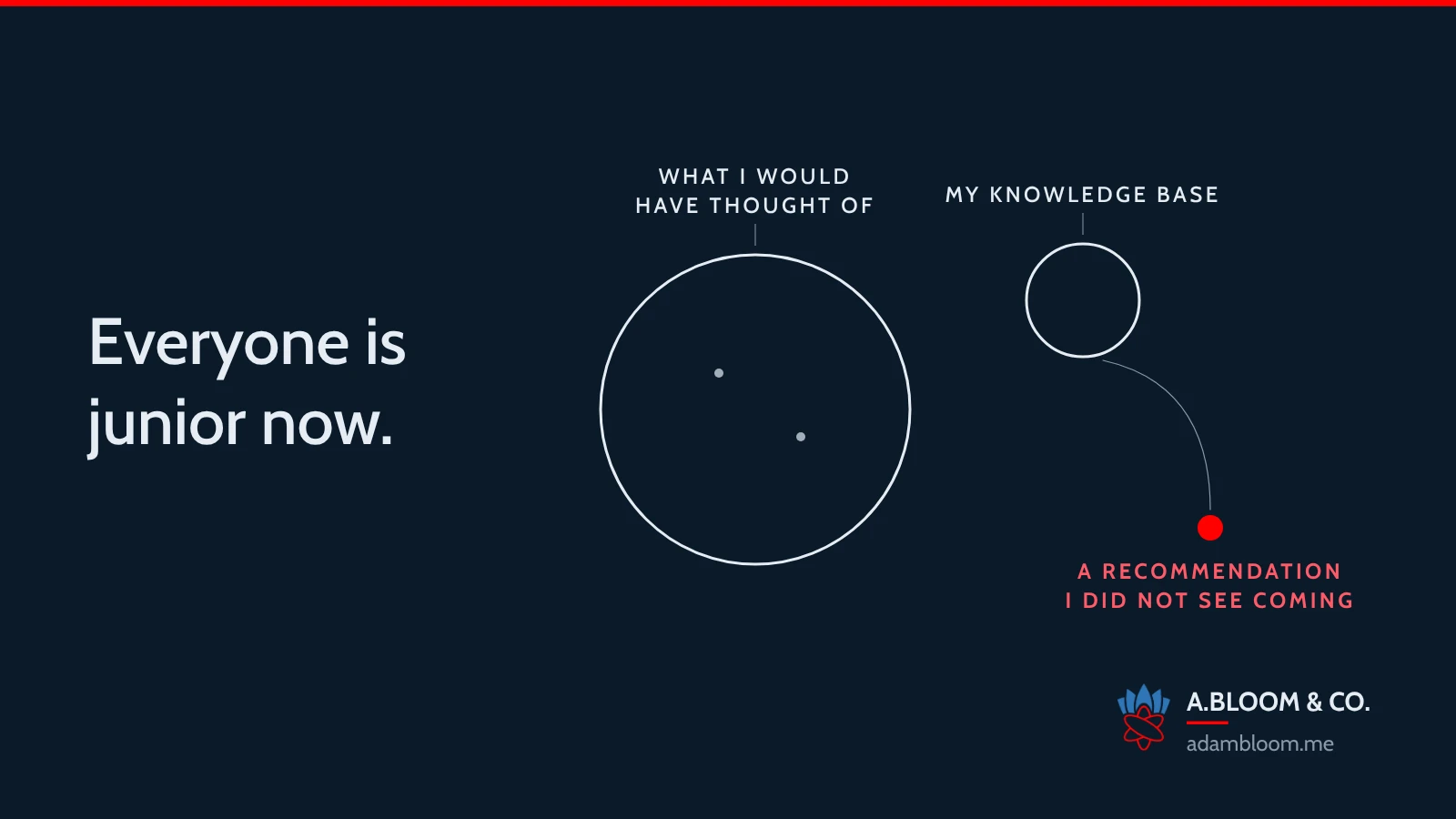
It works through problems faster than I can. It reasons in ways I would never have tried. Then it hands back a recommendation I did not see coming, and it is right on target.
Coding shows this most. It makes recommendations all the time. Give it the right prompts, and the recommendations are very good.
That is an odd feeling after years of experience. I am the senior person in the room. I am also taking notes.
Then I read a post that gave the feeling a name.
Where this idea comes from
The post is We Are All Junior Talent Now by Tomasz Tunguz, a venture capitalist at Theory Ventures. He published it on November 10, 2026. This article is inspired by it, and the credit belongs to him.
Tunguz recaps a session from his Office Hours series. His guest was KC, OpenAI’s Chief People Officer and a former CIO at Palantir. KC’s main point: treating AI as an efficiency tool is the wrong frame.
Here is the logic, as the post tells it. A company can do the same tasks faster. That lifts earnings. Or it can reimagine what the company does. That bends the arc of the whole business. Early on, the two paths look alike. Over time, they pull far apart.
One question in the post grabbed me. What does “junior” even mean now?
Everything below is my reading of that idea, applied to owners like you. Where I am interpreting, I will say so.
Why “junior” and “senior” stopped meaning much
KC was asked how to evaluate junior talent. His answer, in short: drop the labels. Junior usually means you lack experience that is relevant to a particular context. By that definition, he suggested, maybe all of us are junior in the new context.
Tunguz adds a sharp note. What you knew about your work two years ago matters less than what you knew three months ago. Experience has a short shelf life now.
Think about what that does to a job title. “Senior” used to signal years of hard-won judgment. Those years still count. But the tools changed under everyone’s feet at the same time.
A twenty-year veteran and a new hire face the same new tools. Neither has done this before. The veteran knows the business better. The new hire may have fewer old habits to unlearn. Both are beginners at the new work.
Interpretation: I do not read this as “experience is worthless.” I read it as “experience is no longer enough.” It still matters. It just stops being the whole story.
My knowledge-base moments fit this. I know my business deeply. I did not know what the system would find. In that gap, I am a beginner. A well-paid, experienced beginner.

What this means for an owner’s team
This section is my interpretation, not Tunguz’s or KC’s.
If everyone is junior at the new work, a few things change for a business your size.
Hiring. Stop screening for years of experience with a tool that is months old. Screen for how fast someone learns. Ask what they tried last week and what they learned from it.
Titles. The post makes a related point. Every role gains a suffix: agent manager. Tunguz’s own example is that he is not a salesperson but a sales agent manager. The job shifts from doing each task to directing the work and checking it.
Checking the work. This is where seniority still earns its keep. A system can give a recommendation that sounds right and is wrong. Someone must know your business well enough to say, “No, not that one.” That judgment comes from experience in your business. The tool does not bring it.
Busywork. KC’s name for one problem is work on work. People do a task, then log it in a system. Once agents handle the updates, people can spend that time with each other. For a small company, that could mean fewer status chores. It could mean more real conversations with customers and your team.
None of this promises a result. Your business is different from mine, and the tools keep changing. Treat these as questions to test, not rules to follow.

What stays human
KC closed the session on emotional intelligence. He told a story about an oncologist. A patient saw several doctors with the same diagnosis and the same treatment plan. The patient chose this one because of his bedside manner.
KC’s point, as quoted in the post: “The differentiator is how you show up as a human.” He named integrity and humility as part of that.
The logic is simple. When anyone can borrow intelligence beyond their own, raw smarts stop being scarce. What stays scarce is trust, honesty, and care. KC sees this as good news. It points people back toward work worth doing.
Interpretation: Owners already live this. Customers buy from you because they trust you. A larger competitor with better software cannot copy that. It is built one honest conversation at a time.
Interpretation: Humility is also practical. The owner who admits they are learning asks better questions of the system. They also hear more from their team. Feeling junior is not a weakness here. It is a working posture.
Three things to try this month
- Pick one weekly task. Ask an AI system to approach it from scratch. Compare its way with yours. Write down what it saw that you missed.
- Ask your team what they learned. Ask what each person learned about the new tools in the last three months. Share the answers. That is the knowledge that is aging fastest.
- List where you would overrule the system. Write down why. That list is the judgment worth keeping.
Start small and keep notes. No result is guaranteed. The point is to learn how your business behaves with these tools.
Want to talk it through?
If you want to work out what this means for your business, let’s talk.
No pitch. Just a conversation.

Sources and claims
Source: We Are All Junior Talent Now, Tomasz Tunguz, published November 10, 2026. Read through a page-fetch tool that returns a detailed account, not the raw page. Wording of paraphrases and the one quote is marked “via fetch summary” until checked against the live page.
| Claim | Source | Status |
|---|---|---|
| Post published Nov 10, 2026, Office Hours series | Tunguz post | Via fetch summary |
| KC is OpenAI’s Chief People Officer, former Palantir CIO | Tunguz post | Via fetch summary |
| Efficiency is the wrong frame; the two paths diverge over time | Tunguz post (KC’s argument) | Via fetch summary, paraphrased |
| KC: drop the junior and senior labels | Tunguz post (KC’s argument) | Via fetch summary, paraphrased |
| Knowledge from three months ago matters more than from two years ago | Tunguz’s own note in the post | Via fetch summary |
| Every role gains an agent manager suffix; Tunguz’s sales example | Tunguz post | Via fetch summary |
| Work on work: people as middleware for systems | Tunguz post (KC’s term) | Via fetch summary |
| Oncologist story; quote on how you show up as a human | Tunguz post (KC) | Via fetch summary |
| Navier-Stokes claim | OpenAI via the post | Excluded: contested, not needed |
| Knowledge bases surprise me with right-on-target recommendations; coding recommendations are very good with the right prompts | Adam’s own words | Adam’s own experience |
| Hiring, titles, checking the work, busywork, EQ for owners | Adam | Interpretation |
| The three things to try | Adam | Illustration |