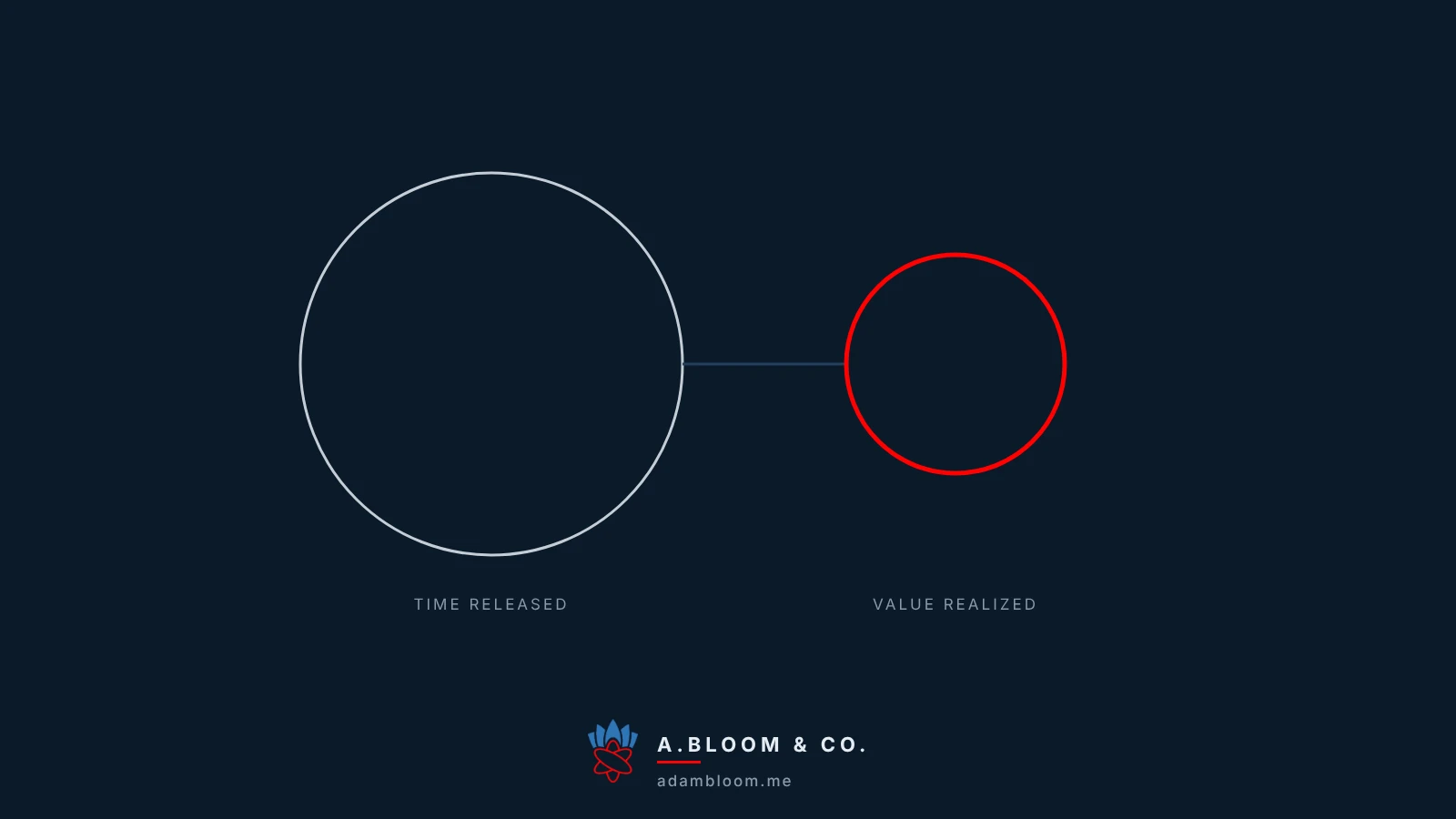
Before you celebrate the time AI gave back, find out what it did for the business.
“It saves us ten hours a week.” That’s a nice sentence. It’s also not a result.
Hours are an activity. Dollars, capacity, and better decisions are outcomes. The gap between them is where a lot of AI projects quietly stall. (Or quietly get declared a success, which is worse.)
Released time isn’t cash
Say a tool frees up a few hours of someone’s week. What happens to those hours? Maybe they go to work that grows revenue. Maybe they go to email. Maybe they vanish into a calendar that was already full.
Nobody is wrong in any of those cases. But only one of them shows up in the business.
So the question isn’t “how much time did we release?” It’s “what did we do with it, and what was it worth?”
Usage isn’t value either
The same trap shows up with activity numbers. How many people logged in. How many prompts ran. How much text came out the other end.
Those numbers are easy to collect. That’s their charm, and their problem. More AI usage isn’t the goal. More value is. Sometimes that means using it less.
Count the whole bill
AI costs less than it used to. That’s the exciting part. But the subscription is rarely the whole cost.
Count the setup and integration. Count the time someone spends reviewing the output. Count training, risk, and maintenance. Count your own time, too (it’s a real cost, even when no invoice arrives).
Then compare that total to what actually changed in the business. A project can look cheap and still lose money. It can also look expensive and pay for itself. You won’t know until you add it all up.

Pick the baseline before you start
This is the step most people skip, because it feels like paperwork. It’s the one that makes everything else possible.
Before the work begins, decide:
- What are we trying to improve? Revenue, margin, capacity, speed, quality, risk. Pick the one that matters for this problem.
- What is the number today? Write it down. If you can’t measure it, say that plainly.
- What would count as a good result? Agree on it in advance, not after you’ve seen the outcome.
- What will we check, and when? A date on the calendar beats good intentions.
The right metric depends on the problem. A sales follow-up process and a month-end close call for different measures. That’s fine. The habit is the same.

Be honest about what you can’t attribute
Sometimes revenue rises after an AI project and you can’t say how much of that was the project. Say so. A candid “probably helped, can’t prove it” is more useful than a confident number you can’t defend.
Fixing one part of a business tends to change something else. Sometimes that’s the problem. Sometimes it’s where the opportunity was hiding. Either way, you want to see it.
A simple test
Here’s a question worth asking after any AI project, yours or one a consultant ran for you:
If we turned this off tomorrow, what would we lose, and what would it be worth?
If the answer is a shrug, the project may be interesting. It isn’t yet valuable.
The page-view problem
I’ve watched plenty of people who commercialize products settle on a metric that produces no measurable value. Page views are the classic.
Page views only matter when they turn into sales. Two million page views is a fine number if it produces $200,000 in revenue. Twenty of those page views producing $200,000? That’s a completely different story.
One number says how many people showed up. The other starts to tell you which ones were worth showing up for. (These figures are illustrations, not a client example.)
AI projects have their own page views: hours saved, prompts run, documents drafted. They’re easy to count. Whether they turn into anything is the part worth measuring.

Where to start
Pick one real problem. Decide what better looks like, in numbers or in plain words. Measure it before and after. Count the full cost. Then decide whether to keep going.
That’s how I approach every engagement: start with one problem, solve it together, and measure the result. If you’d like to talk through yours, book a 30-minute call. No pitch, just a conversation about where your business feels slow, costly, or stuck.

Sources and claims
| Claim | Source | Status |
|---|---|---|
| Released time is not automatically cash savings; AI usage and output volume are not economic outcomes | A.Bloom & Co. Sales & Marketing, measurement rule | Adam’s position |
| Total cost includes integration, review, training, risk, maintenance, and founder/client time | A.Bloom & Co. Business Model, AI economics | Adam’s position |
| Baselines and metrics are chosen per engagement | A.Bloom & Co. Sales & Marketing, measurement rule | Adam’s position |
| Engagements start with one problem, then measure the result | A.Bloom & Co. Sales & Marketing, buyer journey | Adam’s approach |
| Cost of AI is declining | A.Bloom & Co. Sales & Marketing, market trend 1 | Hypothesis, not independently verified |
| Page views matter only when they turn into sales; 2,000,000 views vs. 20 views producing $200,000 | Adam’s own experience; figures are illustrative | Adam’s own experience, Illustration |
| “Probably helped, can’t prove it” is more useful than an undefended number | n/a | Interpretation |